

Coffee tasting is the skill of identifying the aromas, flavours, acidity, sweetness, body, and aftertaste of a coffee. While everyone experiences flavour differently, learning a few simple techniques can dramatically improve your ability to recognise what makes each coffee unique. This guide walks through exactly how to taste coffee like a professional cupper — what to look for, how to train your palate, and how to start recognising the flavour notes that make every origin and processing method distinct.
Quick Answer
Coffee tasting focuses on six primary attributes:
- Aroma
- Acidity
- Sweetness
- Body
- Flavour
- Aftertaste
With practice and comparison, anyone can develop a better coffee palate.
What is Coffee Tasting?
Coffee tasting is the structured practice of evaluating a coffee’s sensory qualities — not a guessing game, and not the same ritual as wine tasting, even though the two share some vocabulary.
Not Wine Tasting
While coffee tasting borrows some language from wine — body, acidity, finish — coffee is evaluated against its own distinct framework, built around brewing variables and roast level that simply don’t apply to wine.
Not Guessing Flavours
Tasting coffee isn’t about forcing yourself to name an exotic fruit because it sounds impressive — it’s about noticing what’s actually present in the cup and finding the closest familiar reference point for it.
Understanding Coffee
At its core, tasting is a tool for understanding a coffee on its own terms — where it came from, how it was processed, and how it was roasted all leave traces you can learn to recognise.
Evaluating Quality
Professional tasting, called cupping, is also how the entire industry grades and prices coffee — the same skill you’re building here is the foundation of the formal scoring system used to certify specialty coffee.
Why Every Coffee Tastes Different
No two coffees taste identical, even from neighboring farms, because so many variables stack on top of each other before a bean ever reaches your cup.
Variety
Different coffee varieties carry distinct genetic flavour tendencies — some lean naturally sweeter, others brighter or more floral — long before farming or processing decisions come into play.
Altitude
Higher altitude slows cherry ripening, allowing more complex sugars and acids to develop, which is part of why high-grown coffees are often prized for brighter, more layered flavour.
Soil
Mineral content and soil composition subtly shape a plant’s growth and the cherry’s eventual chemistry, contributing to the sense of “place” experienced cuppers can sometimes pick out blind.
Processing
How the fruit is removed from the seed — washed, natural, honey, or more experimental routes — has an enormous effect on sweetness, body, and acidity. See our full Coffee Processing Guide for the complete breakdown.
Roast
Roast level reshapes flavour dramatically, with lighter roasts preserving origin character and darker roasts building bold, roast-driven flavour that can mask some of that original character.
Brewing
Even the same roasted bean can taste different depending on grind size, water temperature, and brew ratio — which is why tasting is as much about your brewing setup as it is about the coffee itself. For background on origin, also see our Indian Coffee Regions and Arabica vs Robusta guides.
The Six Things You Should Taste
Aroma
- Chocolate
- Caramel
- Floral
- Berry
Acidity
- Bright
- Crisp
- Juicy
- Not sour
Sweetness
- Brown sugar
- Honey
- Caramel
- Fruit
Body
- Tea-like
- Silky
- Creamy
- Heavy
Flavour
- The actual taste
- Combines aroma + tongue
Aftertaste
- Lingering finish
- Short or long
Aroma
Smell shapes the majority of what we perceive as flavour, which is why professional tasters always smell a coffee — dry grounds, then wet, freshly poured grounds — before ever taking a sip. Common aroma notes include chocolate, caramel, floral, and berry.
Acidity
In cupping, acidity refers to a bright, lively, structured quality — not sourness. Look for words like bright, crisp, and juicy rather than anything unpleasant or sharp.
Sweetness
Natural sugars developed during ripening and processing show up here as brown sugar, honey, caramel, or fruit-like sweetness, distinct from any sugar added afterward.
Body
Body describes the weight and texture of the coffee on your tongue, ranging from light and tea-like to silky, creamy, or genuinely heavy.
Flavour
Flavour is the combination of taste and aroma working together — the actual character you’d describe to someone else, built from everything else on this list happening at once.
Aftertaste
The flavour and quality that lingers after you swallow, which can be short and clean or long and complex depending on the coffee and how it was processed.
Understanding Coffee Flavor Notes
Here’s an important clarification that trips up a lot of beginners: coffee doesn’t contain blueberries, jasmine, or caramel. There’s no fruit or candy hidden inside the bean.
What’s actually happening is chemical. Coffee contains hundreds of aromatic compounds, and many of these compounds are the exact same — or extremely similar — molecules found in blueberries, citrus, or chocolate. When your brain detects those compounds, it reaches for the closest familiar reference point it has, which is why tasters describe coffee using fruit, flower, and spice language even though none of those things are literally present.
This is also why flavour notes printed on a coffee bag aren’t claims or promises — they’re a roaster’s best attempt at describing what they tasted, using language you’re likely to recognise from your own experience eating actual fruit, chocolate, or spices.
Using the Coffee Flavor Wheel
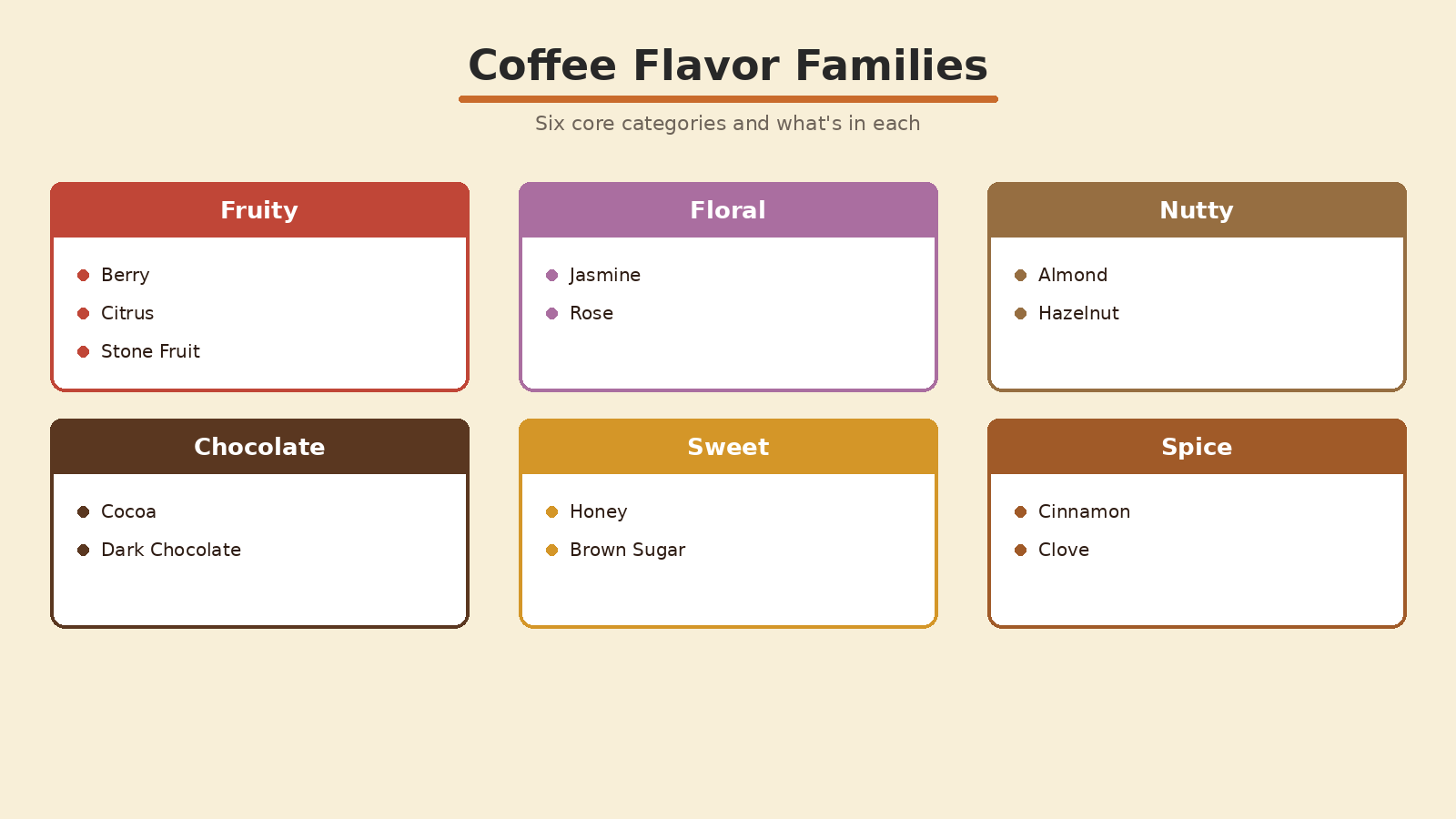
The SCA Coffee Flavor Wheel is the industry-standard tool for naming what you taste, organized from broad to specific so you can zoom in gradually rather than guessing wildly.
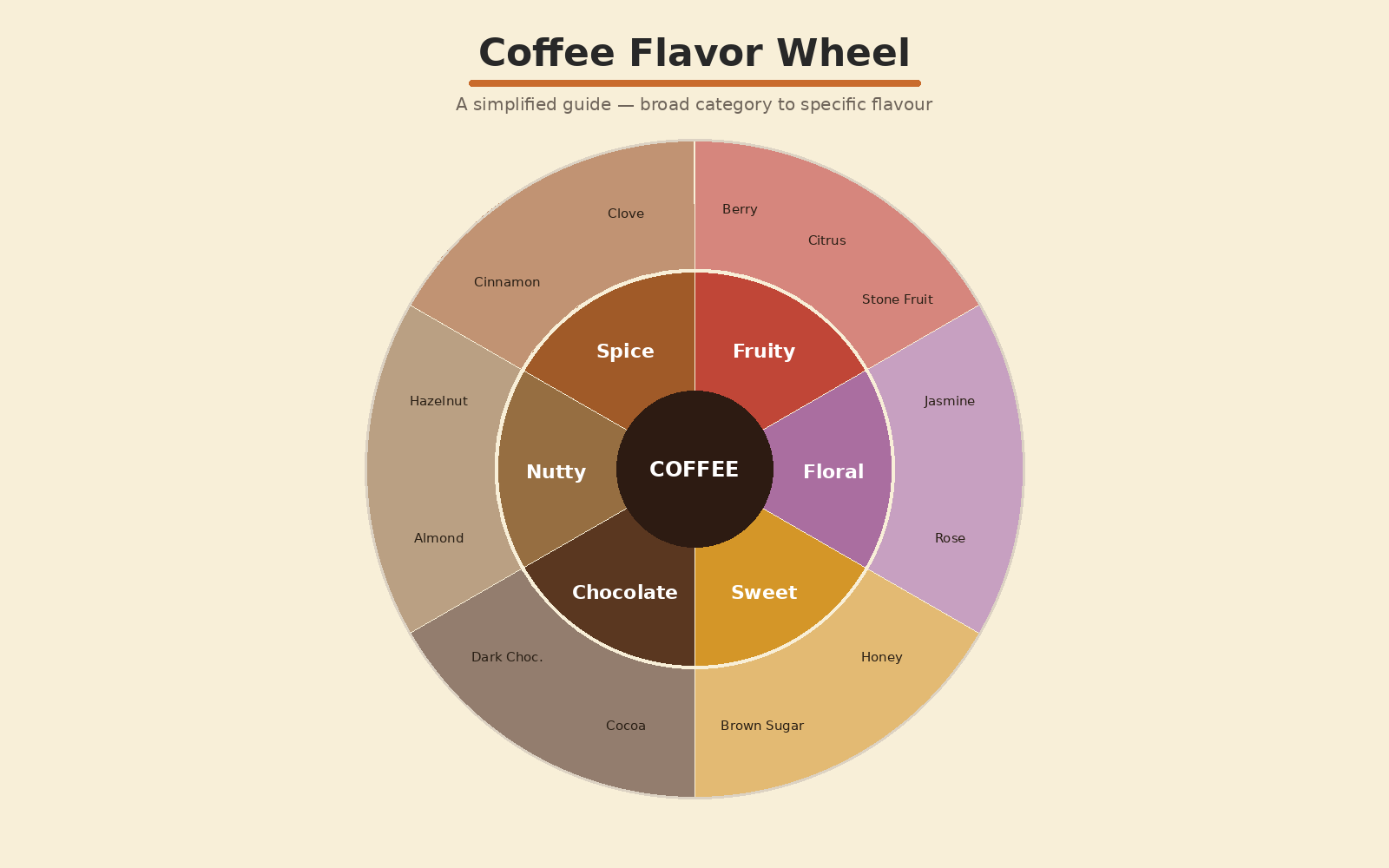
Start at the center and work outward. If you notice something fruity, move to the “Fruity” wedge, then narrow further into “Berry,” and finally to a specific note like “blueberry” or “blackberry.” This step-by-step narrowing is far more reliable than trying to name an exact flavour from scratch, and it’s exactly how professional cuppers build their vocabulary over time.
Coffee Flavor Families
| Family | Examples |
|---|---|
| Fruity | Berry, Citrus, Stone Fruit |
| Floral | Jasmine, Rose |
| Nutty | Almond, Hazelnut |
| Chocolate | Cocoa, Dark Chocolate |
| Sweet | Honey, Brown Sugar |
| Spice | Cinnamon, Clove |
How to Develop Your Coffee Palate
Like any sensory skill, tasting improves with deliberate practice — here are ten ways to build yours faster.
1. Taste Fruit
Eat real blueberries, citrus, and stone fruit on their own so you have an accurate mental reference point when those flavours show up in coffee.
2. Taste Chocolate
Try dark chocolate of varying cocoa percentages — the bitterness and depth scale you notice there maps directly onto how coffee’s chocolate notes vary by roast and origin.
3. Taste Spices
Smell cinnamon, clove, and cardamom directly from the jar — isolating the aroma on its own makes it far easier to recognise embedded in a complex cup later.
4. Compare Coffees
Brew two different coffees side by side rather than one at a time — direct comparison reveals differences your memory alone would miss.
5. Drink Blind
Taste without knowing the origin or processing method first, then check afterward — this trains you to trust what you actually taste rather than what you expect to taste.
6. Use a Notebook
Write down what you taste every time, even briefly — the act of putting words to flavour is what builds vocabulary and memory over time.
7. Drink Slowly
Resist the urge to gulp — let the coffee sit on your palate for a moment before swallowing, since slower sipping reveals far more than a quick drink.
8. Smell Before Tasting
Always smell the coffee before sipping — aroma primes your brain for what you’re about to taste and often reveals notes the palate alone would miss.
9. Cup With Friends
Tasting in a group and comparing notes out loud exposes you to descriptors and perceptions you wouldn’t have reached on your own.
10. Try Different Brewing Methods
The same beans brewed as pour-over, French press, and espresso will highlight different attributes — exploring multiple methods broadens your reference range significantly.
Coffee Cupping Explained
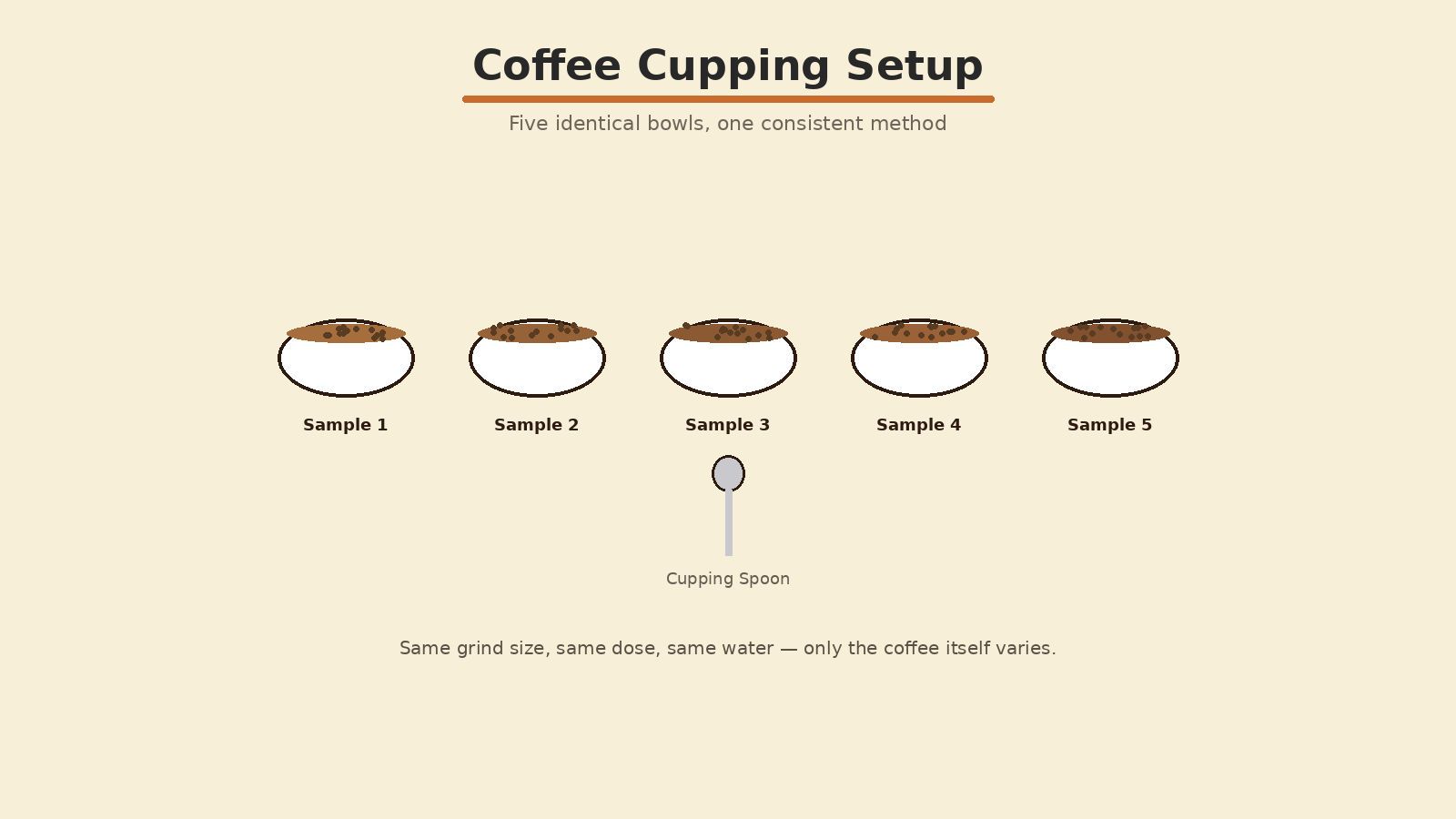
Cupping is the standardized method the entire coffee industry uses to evaluate and grade coffee, designed to remove as much variability as possible so different samples can be compared fairly.
In a professional cupping session, multiple coffees are ground to the same size, dosed at the same ratio, and steeped in identical water at the same temperature — the only variable left to evaluate is the coffee itself.
Coffee Cupping at Home
Equipment
You’ll need identical cupping bowls or glasses, a spoon for breaking the crust and tasting, a kettle, a scale, and a grinder capable of a consistent medium-coarse grind.
Water
Use filtered water heated to roughly 93–96°C, poured directly over the grounds without any pre-infusion or bloom step.
Ratio
A standard cupping ratio is about 8.25 grams of coffee per 150ml of water — slightly stronger than a typical brew, since cupping is built for evaluation rather than drinking pleasure.
Breaking the Crust
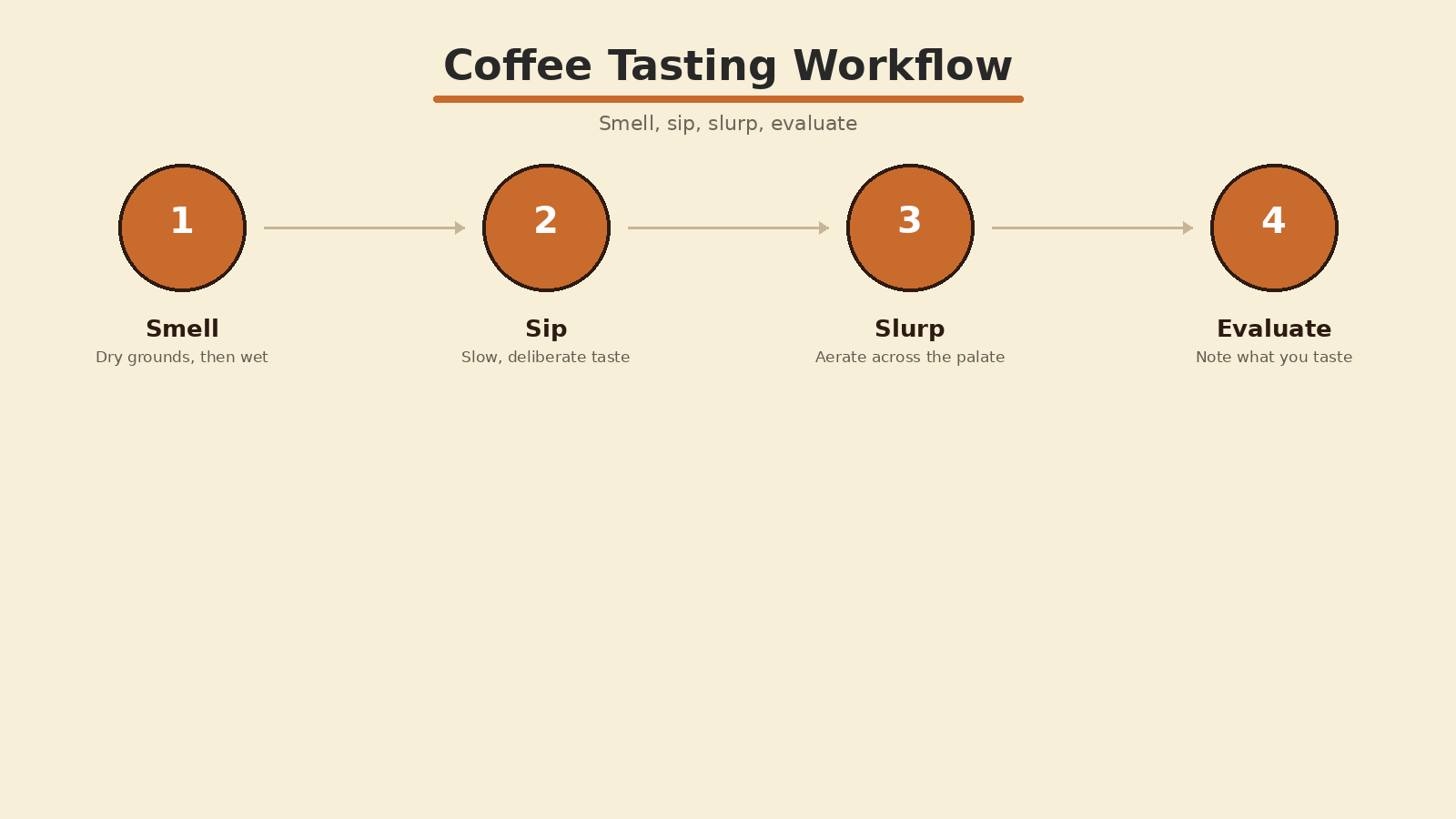
After roughly four minutes of steeping, a crust of grounds forms on the surface — break it gently with a spoon while leaning in close to capture the burst of aroma this releases.
Slurping
Professional cuppers slurp loudly and deliberately, drawing coffee across the palate as a fine spray to maximize contact with taste receptors and aromatic pathways at the back of the throat.
Scoring
Each cup is scored across fragrance, acidity, sweetness, body, balance, and aftertaste, typically on a 6–10 scale per category, building toward the familiar 100-point system used to certify specialty coffee.
Coffee Tasting Journal
Keeping a simple tasting log is one of the fastest ways to build a reliable palate — use this template for every coffee you try.
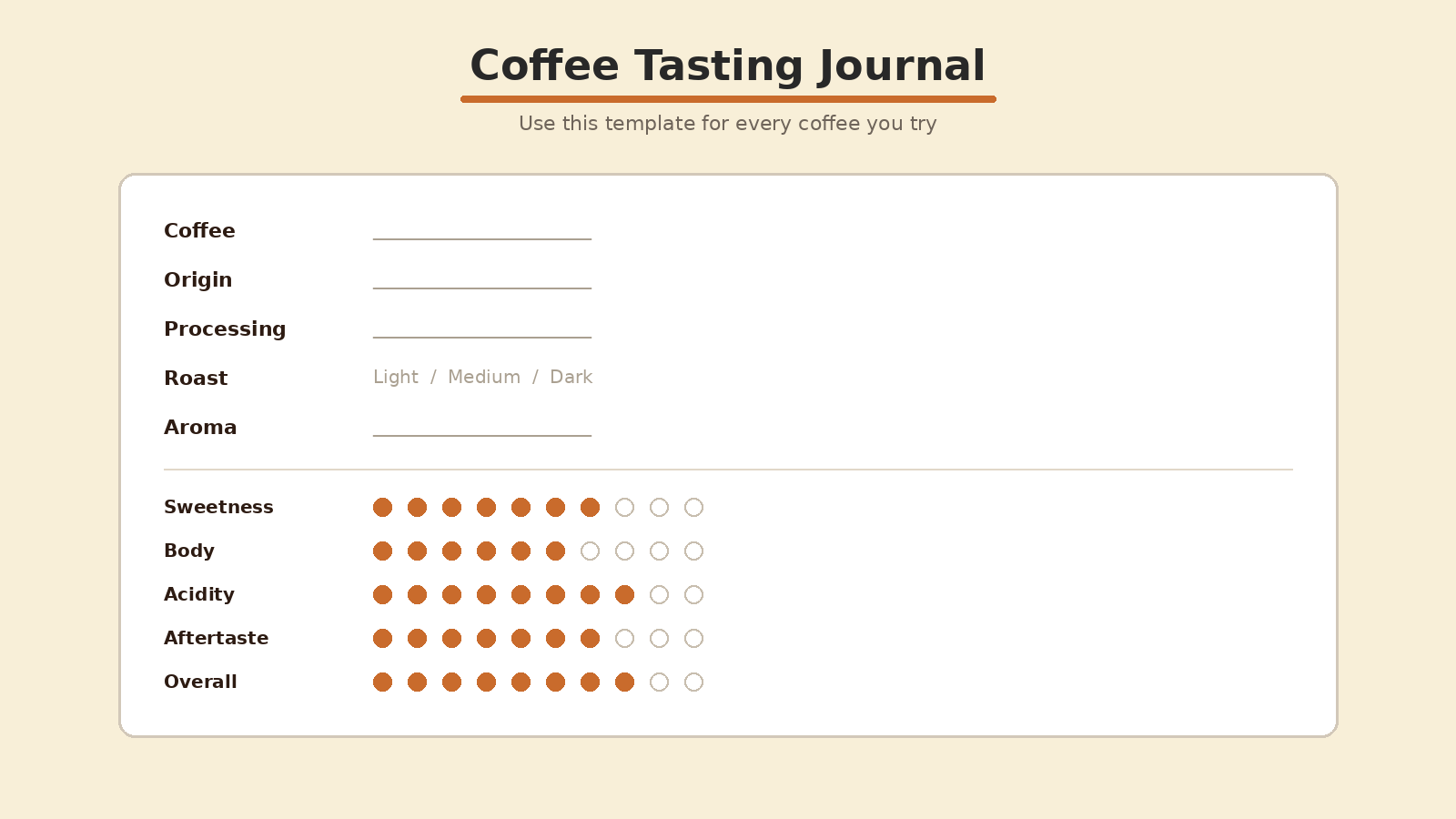
| Field | Notes |
|---|---|
| Coffee | Name / lot |
| Origin | Farm, region, country |
| Processing | Washed, natural, honey, etc. |
| Roast | Light, medium, dark |
| Aroma | What you smelled |
| Sweetness | 1–10 |
| Body | 1–10 |
| Acidity | 1–10 |
| Aftertaste | 1–10 |
| Overall | 1–10 |
Common Beginner Mistakes
Beginner Tasting Checklist
- Smell the dry grounds first
- Smell again once wet
- Let the coffee cool slightly
- Take a slow, deliberate sip
- Note acidity, sweetness, and body
- Identify the aftertaste
- Write down at least one descriptor
- Compare against a second coffee if possible
Try This Tasting Exercise
Building flavour memory works best when you taste reference flavours right before tasting coffee, so your brain has a fresh comparison point.
Taste each reference item slowly, noting its specific character, then taste your coffee immediately after. You’ll often find yourself picking up on echoes of one or more of those references — that’s exactly the kind of association-building professional tasters rely on.
Pair Coffee with Food
Pairing coffee with a matching food reference is another effective way to train your palate to recognise specific notes.
↓
Cheese
↓
Berries
↓
Roasted Nuts
Tasting a coffee alongside a complementary food gives your palate a real-world anchor — pairing a chocolatey medium roast with a piece of mild cheese, for example, often makes the coffee’s sweetness and body easier to notice than tasting it alone.
Frequently Asked Questions
What is coffee cupping?
Cupping is the standardized method used to evaluate and grade coffee, where multiple samples are brewed identically and tasted side by side to compare quality fairly.
Can anyone taste flavour notes?
Yes. Flavour perception is a trainable skill, not an innate talent — with practice, most people can learn to identify a meaningful range of coffee flavour notes.
Why can’t I taste berries?
It often just takes practice and reference — taste real berries on their own first, then revisit the coffee, since having a fresh mental reference point makes the connection much easier to spot.
Does brewing affect flavour?
Significantly. Grind size, water temperature, and brew ratio all change how much of a coffee’s sweetness, acidity, and body actually make it into the cup.
Should coffee taste sour?
No. A well-extracted coffee tastes bright and acidic, not sour — sourness usually signals under-extraction, a grind that’s too coarse, or water that’s too cool.
Why do coffees taste fruity?
Fruity notes typically come from natural or honey processing, where the bean stays in extended contact with the cherry’s sugars during drying, developing compounds that resemble real fruit.
Can milk hide flavour?
Yes. Milk’s fat and sweetness can mute a coffee’s more delicate acidity and origin character, which is why black coffee tasting is the standard for serious flavour evaluation.
How do professionals taste coffee?
Through structured cupping — smelling dry and wet grounds, breaking the crust, slurping loudly to aerate the coffee across the palate, and scoring it against a standardized rubric.
Is coffee tasting the same as wine tasting?
Similar in spirit but not identical — coffee tasting has its own vocabulary and evaluation framework built around brewing variables that don’t apply to wine.
Do I need expensive equipment to taste coffee properly?
No. A grinder, a kettle, and a notebook are enough to start — professional cupping equipment helps standardize comparisons but isn’t required to build your palate.
Why does the same coffee taste different each time I brew it?
Small variations in grind size, water temperature, or brew time can shift extraction enough to noticeably change the cup, even using the same beans.
What does “body” actually mean in coffee?
Body refers to the weight and texture of the coffee on your tongue — how light, silky, or heavy it feels, independent of its specific flavour notes.
How long does it take to develop a coffee palate?
Most people notice meaningful improvement within a few weeks of regular, deliberate tasting — it’s a skill that compounds quickly with consistent practice.
Should I taste coffee black or with milk?
Black, if you’re trying to evaluate flavour seriously — milk can mask the acidity and subtler notes that black coffee reveals clearly.
What’s the difference between flavour and aftertaste?
Flavour is what you taste while the coffee is in your mouth; aftertaste is what lingers after you swallow, which can be short and clean or long and complex.
Continue Learning
What is Specialty Coffee
→
Coffee Processing Methods
→
Honey Process Coffee Guide
→
Arabica vs Robusta
→
Roast Levels Guide
→
Grind Size Guide
→
Indian Coffee Regions
→
Put Your Palate to the Test
For Fruity Notes
For Chocolate Lovers
For Experimental Tasting
For Processing Comparison
Train Your Palate, One Cup at a Time
The fastest way to build your coffee palate is to taste broadly — explore our full specialty range and start building your own flavour vocabulary.