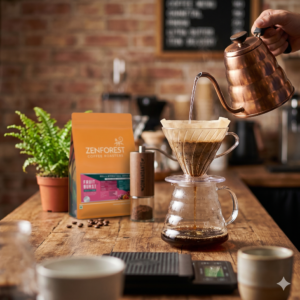

Every cup of coffee is a chemistry experiment — whether or not the person brewing it knows it. Water at a specific temperature dissolves specific compounds from ground coffee at a specific rate, and the result of that process lands somewhere on a spectrum between under-extracted sourness and over-extracted bitterness. Understanding the science behind that process doesn't make brewing more complicated. It makes it easier — because once you understand why the variables matter, you know what to adjust and in which direction when something goes wrong.
This guide covers the complete scientific foundation of brewing: extraction chemistry, bloom and CO2, water quality, grind physics, brewing ratios, and temperature — plus how they all interact.
Quick Answer
Coffee brewing is an extraction process — hot water dissolves soluble compounds from ground coffee into a beverage. The key variables controlling extraction are grind size (surface area), water temperature (extraction energy), brew time (contact duration), agitation (mixing), and water quality (mineral content). Getting these variables in the right range for your method produces a balanced, sweet extraction. Outside that range in either direction — under or over — the cup suffers.
What Extraction Actually Is
Extraction is the transfer of soluble material from the coffee grounds into the brewing water. When hot water contacts ground coffee, it acts as a solvent, dissolving compounds from the surface of each particle inward. The rate of that dissolution — and which compounds dissolve — is controlled by the variables discussed throughout this guide.
Only about 30% of a roasted coffee bean's mass is actually soluble in water. The remaining 70% is cellulose and other insoluble material that stays behind in the grounds. The ideal extraction draws out approximately 18–22% of that soluble material, hitting the range where acids, sugars, and aromatic compounds are balanced and the bitter compounds that come out last are minimised.
The Extraction Spectrum
| Extraction Level | % Extracted | How It Tastes |
|---|---|---|
| Under-extracted | Below 18% | Sour, sharp, thin, underdeveloped |
| Ideal extraction | 18–22% | Balanced, sweet, complex, clean finish |
| Over-extracted | Above 22% | Bitter, harsh, astringent, hollow |
What Gets Extracted and When
The soluble compounds in coffee don't all dissolve at the same rate. They extract in a roughly predictable order, which is why the same set of grounds will produce a sour cup if extraction stops too early and a bitter one if it continues too long.
The Extraction Sequence
First to extract — acids (first 15–20% of extraction time): Organic acids — citric, malic, phosphoric, tartaric — dissolve quickly and produce brightness and acidity. Under-extracted coffee tastes predominantly acidic and sour because extraction stopped here.
Next — sugars and aromatic compounds (the sweet spot): The natural sugars and complex aromatic compounds responsible for a coffee's sweetness, fruit notes, chocolate, and floral character dissolve during the middle of extraction. This is the window the ideal extraction targets.
Last to extract — bitter compounds: Chlorogenic acid breakdown products, phenols, and other bitter compounds dissolve slowest and accumulate toward the end of extraction. Over-extracted coffee tastes predominantly bitter and astringent because water kept dissolving into this final category. See our guide to why coffee tastes bitter for practical fixes.
Under vs Over Extraction: Diagnosis
Being able to diagnose which direction your extraction is off is the most practically useful skill in brewing. Under-extraction and over-extraction have distinct flavour signatures:
Under-Extracted
Sour, sharp, thin body. Tastes like it needs something — often misread as "weak." Coffee flavour doesn't fully develop. Fix: grind finer, use hotter water, or brew longer.
Ideal Extraction
Balanced between sweet and bright. Flavour is full but not aggressive. Sweetness is present. Finish is clean and pleasant. Body suits the method used.
Over-Extracted
Bitter, harsh, often dry or astringent. Sweetness is masked. Finish is unpleasant. Fix: grind coarser, use cooler water, or shorten brew time.
For a deeper dive, see our full Coffee Extraction guide.
The Science of Grind Size
Grind size controls extraction rate by changing the surface area of coffee particles exposed to water. A finer grind creates dramatically more surface area from the same mass of coffee — more surface area means faster extraction.
Particle Size Distribution
This is where burr grinders and blade grinders differ fundamentally. A quality burr grinder produces particles that are roughly uniform in size — all extracting at approximately the same rate. A blade grinder produces a wide distribution: some fine powder (extracting instantly and over-extracting quickly) and some large chunks (barely extracting at all). The result is a cup that simultaneously tastes sour and bitter — representing both the over-extracted fine particles and the under-extracted large chunks in the same brew.
Grind Size by Method
Different methods need different grind sizes not just because of taste preference, but because of their extraction mechanics. Immersion methods like French press have water in extended contact with grounds, so a coarser grind prevents over-extraction during the steep. Espresso forces water through grounds under pressure in under 30 seconds, requiring a very fine grind to achieve adequate extraction in such a short time.
See our full Coffee Grind Size Guide with a complete reference table for every method.
Bloom and CO2: The Science
Freshly roasted coffee contains significant amounts of carbon dioxide (CO2) trapped inside the bean's cellular structure, produced during the roasting process. This CO2 continues to off-gas (degassing) for days and weeks after roasting — which is why most specialty coffee bags include a one-way valve to let CO2 escape without letting oxygen in.
What Happens During Bloom
When hot water first contacts ground coffee, it triggers a rapid release of this trapped CO2, causing the grounds to visibly bubble and swell — the bloom. This matters for brewing because CO2 is hydrophobic (repels water). If it isn't released before the main pour, it creates a barrier between water molecules and the coffee surface, causing uneven and less efficient extraction.
How to Bloom
Pour roughly twice the weight of coffee in water (e.g., 40g of water for 20g of coffee) and let it rest for 30–45 seconds before continuing. You should see visible bubbling and the coffee bed rising. Very fresh beans (under one week from roast) may require a slightly longer bloom due to high CO2 content. Minimal bloom indicates stale beans. Full detail in our Coffee Bloom guide.
Water Chemistry
Water makes up over 98% of a brewed cup of coffee, yet it's the variable most home brewers think about least. Water isn't just a carrier for coffee compounds — it's an active participant in extraction. The specific mineral ions in water interact with coffee's acidic compounds in ways that either enhance or inhibit the extraction of desirable flavours.
Magnesium and Calcium
Magnesium ions are particularly effective at binding with coffee's flavour compounds, making them more soluble and easier to extract. This is why water with moderate magnesium content tends to produce brighter, more complex extractions than either distilled water or very soft water. Calcium also plays a role but is less effective than magnesium as an extraction enhancer.
Why Distilled Water Brews Flat
Completely pure, distilled water contains no dissolved minerals — no magnesium, no calcium, nothing. While this sounds ideal (no off-flavours, no hardness), it actually produces a flat, lifeless extraction because the mineral ions that help draw out flavour compounds aren't present. The water can still dissolve coffee, but less efficiently and with less complexity in the result.
Why Very Hard Water Brews Harsh
Conversely, water that's very high in dissolved minerals — particularly calcium carbonate (temporary hardness) — tends to interfere with extraction by competing with and potentially blocking some of the compounds you want dissolved. Very hard water often produces a chalky, harsh cup even with good technique.
The Ideal Range
The SCA recommends water with a TDS (Total Dissolved Solids) of 75–250 ppm for brewing. Most filtered tap water falls within this range. A basic carbon filter is sufficient for most households — its primary job is removing chlorine and off-flavours, not adjusting mineral content. Full detail in our Best Water for Coffee guide.
TDS and Extraction Yield
Professional baristas and quality-control labs measure brewed coffee with a refractometer to determine two numbers: TDS (Total Dissolved Solids in the brewed cup, measured as a percentage) and Extraction Yield (what percentage of the grounds' soluble mass ended up in the cup).
| Measurement | Target Range | What It Tells You |
|---|---|---|
| TDS (brewed cup) | 1.15–1.45% | Strength / concentration in the cup |
| Extraction Yield | 18–22% | How much of the grounds was dissolved |
These measurements aren't necessary for good home brewing — taste is a perfectly reliable guide — but they provide objective data when you're trying to precisely replicate a brew or diagnose a systematic problem.
Temperature Science
Temperature affects extraction rate directly. Hotter water has more kinetic energy, meaning water molecules move faster and collide with coffee compounds more aggressively, dissolving them more quickly. This is why water that's too hot over-extracts — it dissolves the bitter late-stage compounds that cooler water wouldn't reach in the same time frame.
The 90–96°C Window
At 90°C, water extracts efficiently across most of the useful compounds without reaching bitterness in a typical brew time. At 96°C, extraction is more aggressive — useful for very dense, light-roasted beans that are harder to extract. Above 100°C (boiling), you're extracting aggressively enough to scald delicate aromatic compounds before they properly dissolve.
Roast Level and Temperature
Dark roasts have had more of their cellular structure broken down during roasting — they're more porous and extract more easily. Using the top of the temperature range on a dark roast often pushes extraction into bitterness unnecessarily. Light roasts, denser and more structurally intact, often need the higher end of the range to extract fully in the standard brew time. See our Brewing Temperature Guide.
Ratios and Concentration
Brewing ratio controls the concentration of the final cup — how much dissolved coffee material is present per unit of water. This is distinct from extraction quality (whether the right compounds were extracted). A coffee can be correctly extracted but too concentrated (too much coffee per gram of water) or too diluted (too little).
Strength vs Extraction
These two qualities are independent. A coffee brewed at a 1:20 ratio (very loose) can be perfectly extracted but taste weak and watery. A coffee brewed at a 1:10 ratio can be correctly extracted but taste overwhelmingly strong. Adjusting ratio changes strength; adjusting grind/time/temperature changes extraction quality. Understanding this distinction is fundamental to brewing diagnosis.
Agitation and Turbulence
Agitation — stirring, swirling, or turbulent pouring — increases extraction rate by constantly refreshing the water surrounding each coffee particle. Still water surrounding a particle quickly becomes saturated with dissolved compounds, slowing further extraction. Moving water presents fresh solvent continuously.
This is why a gooseneck kettle poured in slow circles produces different results than a wide-mouthed kettle poured in a single stream. The gooseneck allows controlled, even agitation; a single pour creates channelling through the coffee bed. Espresso machines deliberately create turbulence via pressurised water to achieve maximum extraction in the shortest possible time.
Applying the Science: A Practical Framework
When any cup doesn't taste right, work through this diagnostic sequence:
| What you taste | Science tells you | Adjust |
|---|---|---|
| Sour, thin, flat | Under-extraction — too few compounds dissolved | Grind finer OR brew hotter OR brew longer |
| Bitter, harsh, astringent | Over-extraction — too many bitter compounds dissolved | Grind coarser OR brew cooler OR brew shorter |
| Weak but balanced flavour | Correct extraction, wrong ratio | Increase coffee dose |
| Strong but bitter | Over-extraction AND too concentrated | Grind coarser first, then adjust ratio |
| Inconsistent between brews | Variable grind or imprecise measurement | Use a burr grinder and a scale |
The most counterintuitive thing in coffee science: sour coffee needs more extraction, not less. When most people taste something sour, their instinct is that the coffee is "too strong" or "too much" — but sour is always under-extraction. Grind finer or brew hotter, and that sourness will develop into sweetness. This one insight resolves the most common brewing problem in home kitchens.
Common Mistakes
Continue Learning
Supporting Articles in This Cluster
Great Science Needs Great Beans
Fresh, traceable, single-origin coffee — the kind where the science actually reveals something worth tasting.
Shop Whole Bean Coffees →