
Coffee lovers often encounter two terms repeatedly: Arabica and Robusta. These are the two most widely cultivated coffee species in the world and form the foundation of almost every cup of coffee you drink. While both are coffee, they differ significantly in flavour, caffeine content, growing conditions, and overall drinking experience. Understanding these differences can help you choose coffees that better match your taste preferences.
Quick Answer
Arabica and Robusta are the two most cultivated coffee species in the world. Arabica is known for its sweetness, acidity, and complex flavours, while Robusta offers higher caffeine, stronger body, and greater bitterness. Neither is universally better — it depends on your taste and brewing style.
What is Arabica Coffee?
Arabica coffee comes from the species Coffea arabica. It accounts for approximately 60–70% of global coffee production and is widely regarded as the premium coffee species. Arabica plants thrive at higher elevations and require more specific growing conditions.
Typical Arabica characteristics include a smooth flavour, complex sweetness, higher acidity, floral aromas, and fruit-forward notes, along with a lower caffeine content. Many specialty coffees are predominantly Arabica because of this incredible flavour complexity.
History of Arabica
Arabica is the older of the two cultivated species by domestication, first identified and cultivated centuries before Robusta was formally recognized, and it remains the species most associated with coffee's earliest ceremonial and trade history.
Ethiopian Origin
Arabica originates in the highland forests of southwestern Ethiopia, where wild Arabica trees still grow today — making Ethiopia both the genetic birthplace of the species and home to some of its most genetically diverse heirloom varieties.
Global Production
Arabica is grown across a wide coffee belt spanning Latin America, East Africa, and parts of Asia, with Brazil, Colombia, and Ethiopia among the largest producers — though India's high-altitude regions contribute a smaller but increasingly well-regarded share.
Genetic Characteristics
Arabica is genetically self-pollinating and tetraploid, carrying four sets of chromosomes rather than two, a trait that contributes to its more delicate, less hardy growth habit compared to Robusta.
What is Robusta Coffee?
Robusta coffee comes from the species Coffea canephora. Robusta plants are much more resilient and easier to cultivate than Arabica. They naturally tolerate lower elevations, higher temperatures, and pests or diseases far more effectively.
Typical Robusta characteristics include a strong body, earthy flavour, higher bitterness, nutty notes, and significantly more caffeine. Because of these traits, Robusta is commonly used in espresso blends where it contributes exceptional body and a thick crema.
Origin
Robusta originates in the lowland tropical forests of Central and Western Africa, a fundamentally different ecological niche from Arabica's cool Ethiopian highlands — which explains much of why the two species behave so differently in cultivation.
Disease Resistance
Robusta carries a natural resistance to coffee leaf rust and several other diseases that can devastate Arabica crops, making it a far more dependable choice for farmers in regions where these pressures are common.
Climate Tolerance
Robusta tolerates heat, humidity, and inconsistent rainfall considerably better than Arabica, allowing it to be grown successfully at low altitudes where Arabica simply wouldn't survive.
Vietnam and India Production
Vietnam is the world's largest Robusta producer by a wide margin, having built its entire coffee export economy around the species, while India also maintains substantial Robusta production, particularly across Kerala and parts of Karnataka.
Arabica vs Robusta at a Glance
| Feature | Arabica | Robusta |
|---|---|---|
| Scientific Name | Coffea arabica | Coffea canephora |
| Global Production | 60–70% | 30–40% |
| Caffeine | 1.2–1.5% | 2.2–2.7% |
| Acidity | High | Low |
| Sweetness | High | Low |
| Body | Medium | Heavy |
| Aroma | Floral | Earthy |
| Bitterness | Low | High |
| Growing Altitude | 900–2200 m | Sea level–900 m |
| Disease Resistance | Low | High |
| Price | Premium | Lower |

Taste Differences
Flavour and taste are related but distinct — flavour is the specific notes you pick up (chocolate, citrus, nuts), while taste covers the underlying sensory qualities that shape how those notes come across.
Sweetness
Arabica's higher sugar content during cherry ripening translates into noticeably more natural sweetness in the cup, while Robusta tends to taste comparatively flat or even slightly bitter by contrast.
Acidity
Arabica carries a brighter, more defined acidity that gives the cup structure and liveliness, whereas Robusta's acidity is generally low and unremarkable.
Body
Robusta has a notably heavier, thicker body than Arabica, which is part of why it performs so well in espresso, where that weight translates into a fuller mouthfeel.
Aftertaste
Arabica typically leaves a cleaner, shorter aftertaste, while Robusta's aftertaste tends to linger longer and skew more bitter or rubbery if the bean quality isn't high.
Aroma
Arabica is prized for floral, fruity, and sometimes wine-like aromatics, while Robusta leans earthy, woody, and grain-like — distinctly different aromatic families.
Mouthfeel
Arabica generally feels lighter and silkier on the palate, while Robusta feels thicker and more coating, a textural difference you can notice even before considering flavour at all.
Why Does Robusta Have More Caffeine?
Robusta typically contains nearly twice as much caffeine as Arabica. On average, Arabica coffee contains roughly 1.2–1.5% caffeine, whereas Robusta coffee sits around 2.2–2.7%.
Natural Pesticide
Caffeine is mildly toxic to many insects, and Robusta's higher concentration functions as a built-in chemical deterrent against the pests common in the low-altitude, warmer climates where it grows.
Evolution
Because Robusta evolved in lowland environments with greater pest and pathogen pressure than Arabica's cooler highland habitat, it developed a stronger chemical defense system over time, with caffeine concentration as one result.
Heat Resistance
Higher caffeine content is also linked to the plant's broader hardiness profile, helping it cope with the heat stress that comes with growing at lower, warmer elevations.
Insect Defence
Beyond pure toxicity, caffeine in the leaves and cherries disrupts insect feeding behavior, giving Robusta plants a meaningful survival advantage in pest-heavy growing regions.
Growing Conditions
Arabica
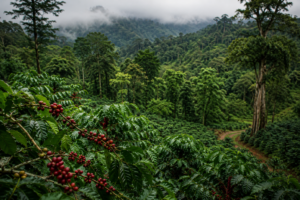
Arabica demands high altitude, typically between 900 and 2200 meters, along with shade-grown cultivation under forest canopy, cooler temperatures, and a slower maturation period that allows more complex sugars and acids to develop in the cherry.
Robusta
Robusta thrives at low altitude, from sea level up to roughly 900 meters, tolerates hot climates with minimal shade, grows considerably faster than Arabica, and produces a meaningfully higher yield per plant — part of why it remains the more economical crop for many farmers.
Arabica vs Robusta Bean Shape

Arabica
- Oval bean
- Curved crease
Robusta
- Round bean
- Straight crease
This is one of the fastest ways to visually tell the two apart even before roasting — Arabica's elongated, curved-crease shape contrasts clearly against Robusta's smaller, rounder form with its distinctive straight center line.
Arabica vs Robusta in Espresso
Arabica in Espresso
- Sweeter
- Fruity
- Balanced
Robusta in Espresso
- Thicker crema
- More caffeine
- Heavier body
Many traditional Italian-style espresso blends include a portion of Robusta specifically for the thicker, longer-lasting crema and extra body it contributes, while single-origin Arabica espresso has become increasingly popular in specialty cafés for its cleaner sweetness and fruit-forward character.
Why Specialty Coffee Uses Arabica
Most specialty coffee producers focus heavily on Arabica because it inherently offers greater complexity, more nuanced flavours, better sweetness, and wider flavour diversity. Depending entirely on its microclimate origin and regional processing methods, an Arabica cup can express vibrant notes of chocolate, caramel, citrus, berries, tropical fruits, and delicate flowers.
Higher Sugars
Arabica cherries develop more sugar during their slower, higher-altitude ripening process, which translates directly into a sweeter, more complex cup once roasted.
Better Acidity
The bright, well-defined acidity Arabica is known for gives cuppers more to evaluate and score favorably, since structured acidity is one of the core categories on the SCA cupping form.
Flavour Complexity
Arabica's genetic diversity and sensitivity to terroir mean the same variety can taste dramatically different depending on where it's grown, giving specialty roasters far more flavour territory to explore than Robusta typically offers.
SCA Scoring
Arabica simply scores higher more consistently on the SCA's 100-point cupping scale, largely because its flavour attributes — acidity, sweetness, aroma — align closely with what the scoring system was built to measure.
Microclimate Expression
Because Arabica is so responsive to altitude, soil, and shade, it expresses microclimate differences far more distinctly than Robusta, which is part of why single-origin Arabica lots can taste so different from one estate to the next.
Can Robusta Be Specialty Coffee?
The Coffee Quality Institute (CQI) introduced formal Fine Robusta Standards specifically to grade Robusta on its own merits rather than measuring it against Arabica's scoring framework. India has been an early and active participant in this movement, alongside Uganda and Vietnam, both of which are investing heavily in quality-focused Robusta production as international demand for well-processed, high-grade Robusta continues to grow.
Arabica vs Robusta in India
India is one of the few major origins producing meaningful volumes of both species, giving it a genuinely dual coffee identity.
Arabica in India
India's Arabica heartland runs through Chikkamagaluru, Coorg, and Baba Budangiri — high-altitude, forest-shaded regions in the Western Ghats that produce some of the country's most celebrated, complex specialty lots.
Robusta in India
Robusta dominates in Kerala and parts of Karnataka, alongside Wayanad's warm, humid lowlands, where the species' heat tolerance and disease resistance make it the more practical, reliable crop.
This dual production gives India a genuine advantage — the same country can supply both a bright, high-altitude Arabica single origin and a full-bodied, dependable Robusta for espresso blending, often from estates just a few hours apart. For a deeper regional breakdown, see our Indian Coffee Regions Guide.
Explore Indian Specialty Coffee
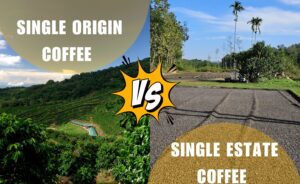
Learn how origin influences flavour and discover why specialty coffee enthusiasts pay close attention to sourcing and terroir. Explore our comprehensive guide to Single Origin vs Single Estate Coffee.
Read Single Origin vs Single Estate →Which Coffee Should Beginners Choose?
| If you like... | Choose... |
|---|---|
| Chocolate | Arabica |
| Fruity | Arabica |
| Strong coffee | Robusta |
| Espresso | Blend |
| Milk drinks | Blend |
| Black coffee | Arabica |
Neither species is objectively better than the other; the absolute best choice always comes down to your personal flavour preference. Choose Arabica if you enjoy complex cup profiles, bright fruit-forward notes, delicate sweetness, and deep specialty coffee exploration. Choose Robusta if you enjoy a remarkably strong body, high caffeine kick, traditional rich coffee profiles, and intense, heavy-crema espresso.
Common Myths
Frequently Asked Questions
Is Arabica healthier than Robusta?
Both species offer very similar health benefits, essential nutrients, and rich antioxidants. The primary difference lies in their taste and caffeine concentrations, rather than nutritional value.
Why is Arabica more expensive?
Arabica is far more delicate and difficult to cultivate safely, requiring higher elevations and intensive care. It generally commands higher market prices due to its labour-intensive production and superior flavour quality.
Which has more caffeine?
Robusta does, containing roughly 2.2–2.7% caffeine compared to Arabica's 1.2–1.5%, nearly double the concentration.
Is Robusta stronger than Arabica?
Yes. Because Robusta contains roughly double the caffeine content of Arabica and features a heavier, more bitter flavour profile, it is universally perceived as a much stronger cup.
Can Robusta be specialty coffee?
Yes. Under the Fine Robusta movement and CQI's dedicated grading standards, carefully grown and processed Robusta can qualify as genuine specialty coffee.
Which is better for espresso?
It depends on what you want — Arabica gives a sweeter, more balanced shot, while Robusta delivers thicker crema and more body, which is why many blends use both.
Which is less bitter?
Arabica is generally less bitter, thanks to its higher sugar content and lower caffeine concentration, both of which soften the cup's overall bitterness.
Is Arabica organic?
Not automatically — organic status depends on certification and farming practices, not species. Both Arabica and Robusta can be grown organically or conventionally.
Why is Robusta cheaper?
Robusta is easier and cheaper to grow, with higher yields, lower altitude requirements, and far greater disease resistance, all of which reduce production costs significantly compared to Arabica.
Which grows in India?
Both. India produces high-altitude Arabica across Chikkamagaluru, Coorg, and Baba Budangiri, alongside substantial Robusta production in Kerala, Karnataka, and Wayanad.
Which is easier to farm?
Robusta, by a wide margin — it tolerates heat, pests, and inconsistent rainfall far better than the more delicate, climate-sensitive Arabica plant.
Can I mix Arabica and Robusta?
Yes, and many traditional espresso blends do exactly this, combining Arabica's sweetness and acidity with Robusta's body and crema for a more rounded, balanced shot.
Does roast level affect the Arabica vs Robusta difference?
Yes, somewhat — darker roasts mute some of Arabica's distinguishing acidity and sweetness, narrowing the perceptible gap between the two species, while lighter roasts highlight the difference more clearly.
Which species is older?
Arabica has the longer cultivation history, with origins tracing back to wild forests in Ethiopia long before Robusta was formally identified and cultivated in Central Africa.
Which coffee is best for beginners?
Arabica is generally the most approachable choice for beginners because of its smooth, sweet, and less bitter flavour profile.
Continue Learning
Learn More
Find Your Match
Looking for a smooth, fruit-forward Arabica?
Want to try a high-quality Robusta?
Interested in experimental flavours?
Experience Specialty Coffee from India
Explore carefully roasted coffees that showcase the unique, rich flavours of India's most celebrated coffee-growing regions.
Shop Specialty Coffee →