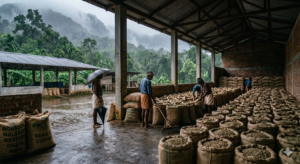

Most of the world’s coffee is grown in open fields under direct sunlight, harvested as quickly as possible, and shipped as efficiently as possible. The coffee growing in India’s Western Ghats works on an entirely different logic. Here, coffee grows in the shade of a dense forest canopy — native trees that were never cleared, biodiversity that was never disrupted, and an ecosystem in which coffee plants are a guest rather than a monoculture. The result is a coffee that tastes demonstrably different: slower to ripen, lower in acidity, more complex in body, and carrying flavour characteristics that can only be traced back to the particular interaction of altitude, rainfall, shade, and soil that define this specific stretch of land.
At Zenforest, every coffee in our range begins here — in the rainforest-shaded estates of Chikkamagaluru and Coorg. Understanding how that environment shapes the bean is the clearest way to understand what makes Indian specialty coffee worth paying attention to.
Quick Answer
Specialty coffee from India’s Western Ghats rainforests is shade-grown under native forest canopies in one of the world’s highest-rainfall regions. This combination — dense tree cover, volcanic soil, high altitude, and slow cherry ripening — produces beans with lower acidity, greater sweetness, heavier body, and more complex flavour than open-field coffee. Indian rainforest coffee is also inherently sustainable: the farming method preserves the forest ecosystem rather than replacing it.
Key Takeaways
- Indian rainforest coffee is shade-grown under native trees — the forest was never cleared for cultivation.
- The Western Ghats is a global biodiversity hotspot and one of the world’s highest-rainfall regions.
- Slow cherry ripening under shade produces more complex, sweeter, lower-acid beans.
- Shade-grown methods are sustainable by default — no deforestation, minimal chemical inputs.
- Processing methods like monsooning and fermentation add further layers of character.
- The EU Deforestation Regulation (EUDR) is increasing traceability and transparency in Indian coffee supply chains.
What is Indian Rainforest Coffee?
Indian rainforest coffee refers to specialty-grade coffee cultivated within or alongside the native forests of India’s Western Ghats, grown under natural tree canopies rather than in cleared, open-field plantations. The defining characteristic is the relationship between the coffee plant and the surrounding forest — in the Western Ghats, that forest was never removed to make way for agriculture. Coffee was planted into an existing ecosystem, and the ecosystem has remained largely intact around it for generations.
This makes Indian shade-grown coffee fundamentally different from most of the world’s coffee, which is typically grown as a monoculture in sun-exposed rows optimised for yield and efficiency. The shade-grown approach sacrifices some of that efficiency in exchange for something more valuable — environmental complexity that translates directly into the flavour of the bean.
Not Just a Marketing Term
Shade-grown and rainforest-grown are sometimes used loosely in coffee marketing, but in the Western Ghats context they describe something specific and verifiable. These estates are situated inside or adjacent to one of the world’s eight recognised biodiversity hotspots. The shade canopy isn’t a few planted trees added for show — it’s native forest cover that predates the coffee cultivation by centuries. That distinction matters both environmentally and for the cup.
The Western Ghats: Where This Coffee Grows
The Western Ghats is a mountain range running roughly 1,600 kilometres down the western edge of the Indian subcontinent, forming a continuous escarpment from Gujarat in the north to Kerala in the south. It is recognised by UNESCO as a World Heritage Site and by Conservation International as one of the world’s eight hottest biodiversity hotspots — a designation given to regions with exceptional concentrations of endemic species facing significant habitat threat.
Chikkamagaluru and Coorg
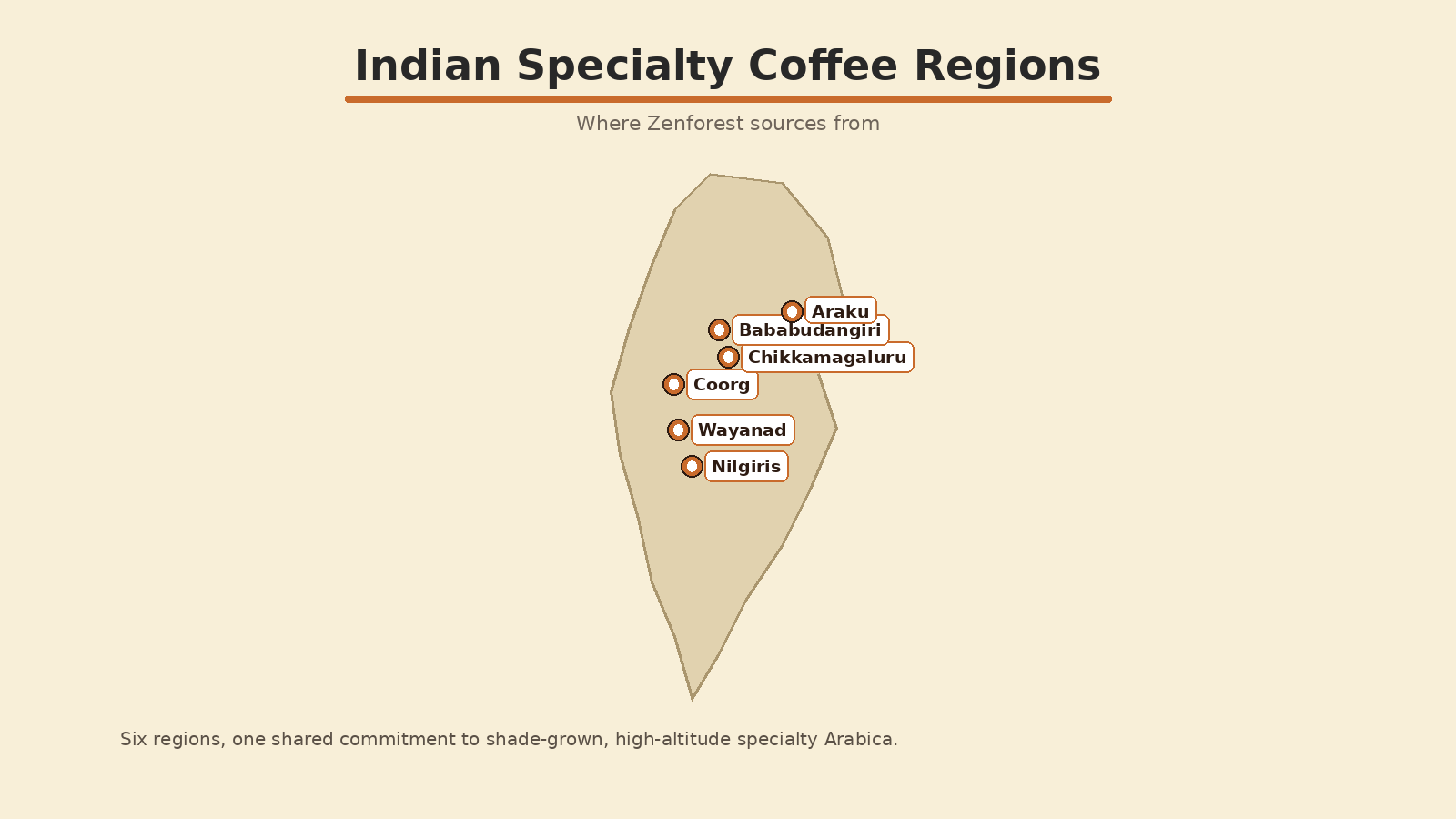
The two regions most associated with premium Indian coffee — Chikkamagaluru (also spelled Chikmagalur) and Coorg (Kodagu) — both sit within the Western Ghats at elevations ranging from roughly 900m to over 1,500m above sea level. Both receive substantial annual rainfall from the southwest monsoon, with some estates recording among the highest rainfall totals in the world during the June to September monsoon season.
It’s this combination of high altitude, dense canopy, and exceptional rainfall that defines the growing environment for Indian rainforest coffee. Learn more about each region in our full Indian Coffee Regions guide.
Altitude and Its Effect on the Bean
As with coffee-growing regions globally, altitude has a significant effect on bean development in the Western Ghats. Higher altitudes mean cooler temperatures, slower cherry ripening, and more time for sugars and aromatic compounds to develop within the bean. This is part of the reason Indian rainforest coffees tend toward sweetness and body rather than sharp brightness — the slow-ripening environment builds density and complexity rather than the high acidity typical of faster-ripening, lower-altitude lots. See our full breakdown in the Arabica vs Robusta guide for how variety interacts with these growing conditions.
How Shade-Grown Coffee Works
In conventional open-field coffee farming, trees are cleared to maximise sunlight exposure, which accelerates cherry ripening and increases yield per hectare. The trade-off is a faster, simpler flavour profile and a significant environmental cost — cleared land, disrupted watersheds, and eliminated habitat.
Shade-grown farming keeps that tree canopy intact and uses it deliberately. The coffee plants grow in the filtered light beneath, which has several important effects.
Temperature Regulation
The canopy keeps soil and air temperatures lower and more stable than open fields, reducing heat stress on the coffee plants and slowing the overall rate of cherry development. This is the foundational mechanism behind shade-grown coffee’s flavour advantages.
Moisture Retention
Tree cover reduces direct rainfall impact on soil, slowing erosion and helping maintain moisture levels more consistently through dry periods. In a region as rainfall-heavy as the Western Ghats, this also prevents waterlogging — the canopy intercepts excess water before it reaches the root zone.
Soil Health
Leaf litter from the canopy trees continuously returns organic matter to the soil, maintaining the nutrient density that the coffee plants draw on. This natural composting cycle reduces the need for external fertiliser inputs, making the farming method inherently lower-input than conventional alternatives.
Biodiversity Support
Native forest canopy supports birds, insects, and other species that play roles in natural pest control. Many shade-grown estates in the Western Ghats are home to endemic species — birds, reptiles, and mammals found nowhere else — that would be lost under cleared monoculture conditions.
Special Characteristics of Rainforest Coffee
Slower Maturation
Shade and altitude combine to slow cherry ripening significantly — often by several weeks compared to open-field equivalents. More time on the branch means more complex sugar development and a denser, richer bean.
Natural Sweetness
The slow ripening process allows more sugars to accumulate in the cherry before harvest, producing a natural sweetness that carries through processing and roasting without any additional intervention.
Lower Acidity
Reduced sun exposure and slower development produce beans with lower concentrations of the organic acids that create brightness in coffee — the result is a smoother, rounder cup profile. See our full breakdown of coffee acidity.
| Growing Factor | Effect on the Bean | Effect in the Cup |
|---|---|---|
| Native shade canopy | Slower cherry ripening | More complex flavour, greater sweetness |
| High altitude | Denser bean structure | Higher perceived quality, more nuanced notes |
| High rainfall | Consistent moisture to roots | Even development, clean body |
| Volcanic soil | Rich mineral content | Depth and complexity |
| Low chemical input | Natural plant stress responses | More layered, complex character |
How the Rainforest Shapes Flavour
The flavour of Indian rainforest coffee isn’t shaped primarily by processing method or roast level alone — though both matter significantly. It starts with the growing environment, which sets the parameters everything else works within.
The Flavour Profile of Western Ghats Coffee
Across origins within the Western Ghats, some characteristic flavour tendencies repeat consistently: chocolate and cocoa notes, roasted nuttiness, mild spice, and a natural caramel sweetness underpinned by a heavy, coating body. Acidity is typically low to medium, with the cup feeling smooth and satisfying rather than sharp or bright.
These aren’t notes that roasters add or manipulate — they’re the baseline character that the combination of altitude, shade, rainfall, and soil produces in the raw bean. What roasting and processing do is develop, highlight, or redirect them. Read more about how this works in our guide to Coffee Flavour Notes.
Why Indian Coffee Tastes Different From African or Latin American Coffee
Coffees from East Africa — Ethiopia, Kenya — are known for their bright acidity and fruit-forward character, driven by high-altitude growing combined with very specific processing traditions and varietal genetics. Latin American coffees tend toward clean, balanced, nut-and-chocolate profiles with variable acidity depending on processing. Indian Western Ghats coffee occupies a different space entirely: heavier body, lower acidity, more grounding earthy and cocoa character — a profile shaped as much by the forest it grows in as by anything the roaster does to it.
Sustainability and the EUDR
The shade-grown farming tradition of the Western Ghats makes Indian rainforest coffee one of the most inherently sustainable in the world — not because of external certification, but because of how the farming model is structured. When coffee is grown within an existing forest canopy rather than replacing it, deforestation doesn’t occur as part of the production process. This distinction is increasingly significant as global trade regulations begin to reflect environmental accountability.
The EU Deforestation Regulation (EUDR)
The EU Deforestation Regulation (EUDR) — which entered force in 2023 — requires that commodities exported to the European Union, including coffee, be verified as deforestation-free and compliant with the origin country’s forest protection laws. Coffee produced using methods that involve forest clearance will face significant barriers to European markets under this regulation.
For Indian shade-grown coffee from the Western Ghats, EUDR compliance is largely a documentation and traceability challenge rather than a production challenge — the farming methods already satisfy the underlying environmental requirements. What’s being built now is the data infrastructure to verify and communicate that compliance clearly to buyers and regulators.
What This Means for Buyers
As EUDR implementation progresses, Indian rainforest coffee producers who can demonstrate documented traceability — farm-level GPS data, forest cover verification, chain of custody records — will be positioned as some of the most compliantly sourced coffees available for European buyers. The farming method that has existed for generations in the Western Ghats turns out to be exactly what modern sustainability standards require.
Biodiversity Protection
Beyond deforestation, shade-grown estates actively support biodiversity. The Western Ghats is home to a disproportionate number of endemic species — animals, birds, plants, and insects found nowhere else on earth. Maintaining the forest canopy across coffee estates means maintaining habitat for these species, which has conservation value that goes well beyond what any sustainability certification could capture.
Zenforest’s Processing Methods
The rainforest environment provides the foundation. What Zenforest does at the processing stage is designed to highlight, amplify, and explore the character that foundation produces. We use both traditional and experimental methods across our range, depending on what best suits the bean’s potential.
Washed Processing
For coffees where origin clarity is the priority, washed processing removes the fruit entirely before fermentation and drying. This produces a cleaner, brighter expression of the bean’s inherent character — ideal for coffees where the growing conditions themselves are the story. See our full guide to coffee processing methods for a complete breakdown.
Honey Processing
Honey processing retains some of the cherry’s mucilage during drying, building additional sweetness and body on top of the bean’s natural character. For rainforest-grown Indian coffees, honey processing amplifies the caramel and chocolate notes that already exist in the bean. Learn more in our Honey Process Coffee Guide.
Monsoon Ageing
One of the most distinctive processing traditions in Indian coffee — exposing green beans to the humid monsoon winds of the Malabar Coast for several weeks before roasting. This transforms the bean’s acidity, body, and flavour character in a way no other processing method replicates. The full story of how and why this works is in our dedicated Monsoon Malabar guide.
Experimental Fermentation
Our experimental range explores extended fermentation, cinnamon co-fermentation, and barrel ageing — techniques that introduce new aromatic dimensions while remaining grounded in the bean’s Western Ghats identity. These methods build on a foundation of quality rather than attempting to mask an ordinary bean — the forest-grown character is always present underneath. Our Rum Barrel Aged Coffee and Cinnamon Fermented are the clearest expressions of this direction.
Curious About Single Origin vs Single Estate?
Does coffee traced to a single estate taste different from a regional blend? Explore how terroir and traceability interact in our guide to origin and estate distinctions.
Read the Origins Guide →Indian Rainforest Coffee vs Other Origins
Understanding how Western Ghats coffee sits in the broader global context helps clarify what makes it worth seeking out.
| Origin | Growing Method | Typical Profile | Acidity |
|---|---|---|---|
| Western Ghats, India | Shade-grown, native canopy | Chocolate, nuts, earth, caramel | Low |
| Ethiopia | Mixed (forest/garden/plantation) | Floral, berry, jasmine | High |
| Colombia | Mostly open sun-grown | Caramel, red fruit, citrus | Medium-high |
| Brazil | Open sun-grown, mechanised | Nuts, chocolate, low acidity | Low-medium |
| Kenya | Open-grown, irrigated | Black currant, tomato, bright | Very high |
Brazil is the closest global parallel to Indian coffee in terms of low acidity and chocolate-nut character, but the comparison breaks down at the level of method. Brazilian coffee is grown at scale using mechanised harvesting in cleared open fields. Indian Western Ghats coffee grows in a forest. The flavour similarity is surface-level; the growing philosophy is opposite.
How to Brew Indian Rainforest Coffee
The heavy body, low acidity, and earthy complexity of Western Ghats coffee respond best to brewing methods that allow full extraction and oil retention.
French Press
The French press is often the best match — immersion brewing with a metal filter lets all of the coffee’s oils and body come through without the paper filter removing them. Use a coarse grind, a 1:15 coffee-to-water ratio, and steep for four minutes.
Espresso
The heavy body and rich cocoa profile translate excellently into espresso. Western Ghats coffees produce thick crema and a deeply satisfying, low-acid shot that holds up well in milk-based drinks. See our Espresso Brewing Guide for dialling in tips.
Moka Pot
The moka pot suits the bold, earthy profile well — the concentrated extraction brings out dark chocolate and spice notes particularly clearly.
Pour Over
A pour over works best for the lighter, washed expressions in our range where origin clarity is the goal — the clean extraction highlights the bean’s natural sweetness without the immersion heaviness of French press.
Brewing Temperature
For the heavier, earthier coffees in this range, brewing slightly cooler — around 90–92°C rather than the top of the 90–96°C window — helps avoid amplifying any bitterness in the already bold profile. Our full Coffee Brewing Temperature Guide covers this in detail.
Who Should Try Indian Rainforest Coffee?
Low-Acid Seekers
The shade-grown environment naturally reduces acidity. If you find most specialty coffee too bright or sharp, Indian rainforest coffees are worth trying before switching to dark roasts.
Sustainability-Conscious Drinkers
If you care where and how your coffee is grown, few origins have a stronger environmental story than shade-grown Western Ghats coffee. The forest was never cleared — the coffee grows within it.
Curious About India’s Coffee Identity
India produces far more interesting coffee than its reputation suggests. The Western Ghats range is the best starting point for understanding what Indian specialty coffee actually tastes like at its best.
If you’re tasting Western Ghats coffee for the first time, compare two coffees from the same region but with different processing — one washed, one honey or natural. The growing environment is the constant; the processing is the variable. This comparison is one of the fastest ways to understand how much processing method shapes flavour on top of the origin’s baseline character.
Common Mistakes
Frequently Asked Questions
What makes shade-grown coffee different from regular coffee?
Shade-grown coffee ripens more slowly under a forest canopy, developing more complex sugars and a denser bean structure. This produces lower acidity, more natural sweetness, and a heavier body than open-field, sun-grown coffee of equivalent roast level.
Is Indian rainforest coffee organic?
Not automatically — organic certification requires a formal inspection and verification process. However, shade-grown Indian coffee typically uses far fewer chemical inputs than conventional open-field farming, because the forest ecosystem provides natural pest control, soil fertility, and moisture management. Some estates are certified organic; others produce coffee in effectively organic conditions without formal certification.
What are the main coffee-growing regions in India?
Chikkamagaluru and Coorg (Kodagu) in Karnataka produce the majority of India’s premium specialty coffee. Araku Valley in Andhra Pradesh and Wayanad in Kerala are also significant producing regions. Each has distinct characteristics shaped by its specific altitude, rainfall pattern, and growing conditions. Our full Indian Coffee Regions guide covers all of them.
What does the EUDR mean for Indian coffee?
The EU Deforestation Regulation requires that commodities exported to Europe — including coffee — be verified as deforestation-free. For shade-grown Indian coffee from the Western Ghats, the farming method already satisfies the underlying environmental requirements. The current work is building documentation and traceability infrastructure to prove that compliance to regulators and buyers.
Does Indian coffee have caffeine levels comparable to other origins?
Yes. Arabica grown in the Western Ghats has caffeine content comparable to other Arabica-producing regions globally. Robusta grown in India has higher caffeine content, as is true of Robusta universally — see our Arabica vs Robusta guide for the full comparison.
Can I taste the “forest” character in the cup?
In a sense, yes. The earthiness and grounding quality common to Western Ghats coffees — the cocoa depth, the low acid, the warm spice in the finish — are direct expressions of the growing environment. It’s not a literal forest flavour, but a cup that reflects the slow, shaded ripening conditions of the rainforest ecosystem in which the bean developed.
Continue Learning
Recommended Coffees
Start With the Classic
Experience the Processing Range
Explore the Full Collection
Learn More
The Forest Is the Flavour
Specialty coffee from the Western Ghats doesn’t need a marketing story — the farming method, the environment, and the flavour tell the story clearly enough on their own. When coffee grows under a native forest canopy in one of the world’s most biodiverse regions, in high-altitude volcanic soil watered by some of the highest annual rainfall on earth, the bean that emerges carries all of that in its character. Smooth, sweet, low-acid, grounding, complex — these are flavours produced by a place, not manufactured by processing.
Choosing Indian rainforest coffee is one of the most straightforward ways to connect what’s in your cup to how it was grown — and to support a farming tradition that has preserved one of the world’s most important ecosystems not by design, but simply by continuing to do what it has always done.
Explore the Rainforest Collection
Bring the rich, biodiverse essence of the Western Ghats to your morning brew. From classic single origins to experimental processing lots, every coffee in our rainforest range begins in the same shade-grown, forest-protected environment.
Shop the Rainforest Collection →