
Indian Coffee Regions - India produces some of the world's most distinctive specialty coffee, yet many coffee drinkers know more about Colombia or Ethiopia than they do about their own coffee-growing regions. From the mist-covered estates of Coorg to the tribal farms of Araku Valley, every Indian region produces beans with completely different characteristics — shaped by altitude, rainfall, soil, and the shade canopy each farm grows under.
Geography matters because coffee is one of the most terroir-sensitive crops grown anywhere. Altitude matters because cooler, slower ripening at height concentrates sugars and acidity into a denser bean. And climate matters because India is the only major coffee-producing country where the crop is grown almost entirely under a monsoon system, in the shade of rainforest canopy rather than in open sun. This guide walks through every major Indian coffee-growing region, what makes each one distinct, and how to choose a coffee based on the flavour you're actually looking for.
Quick Answer
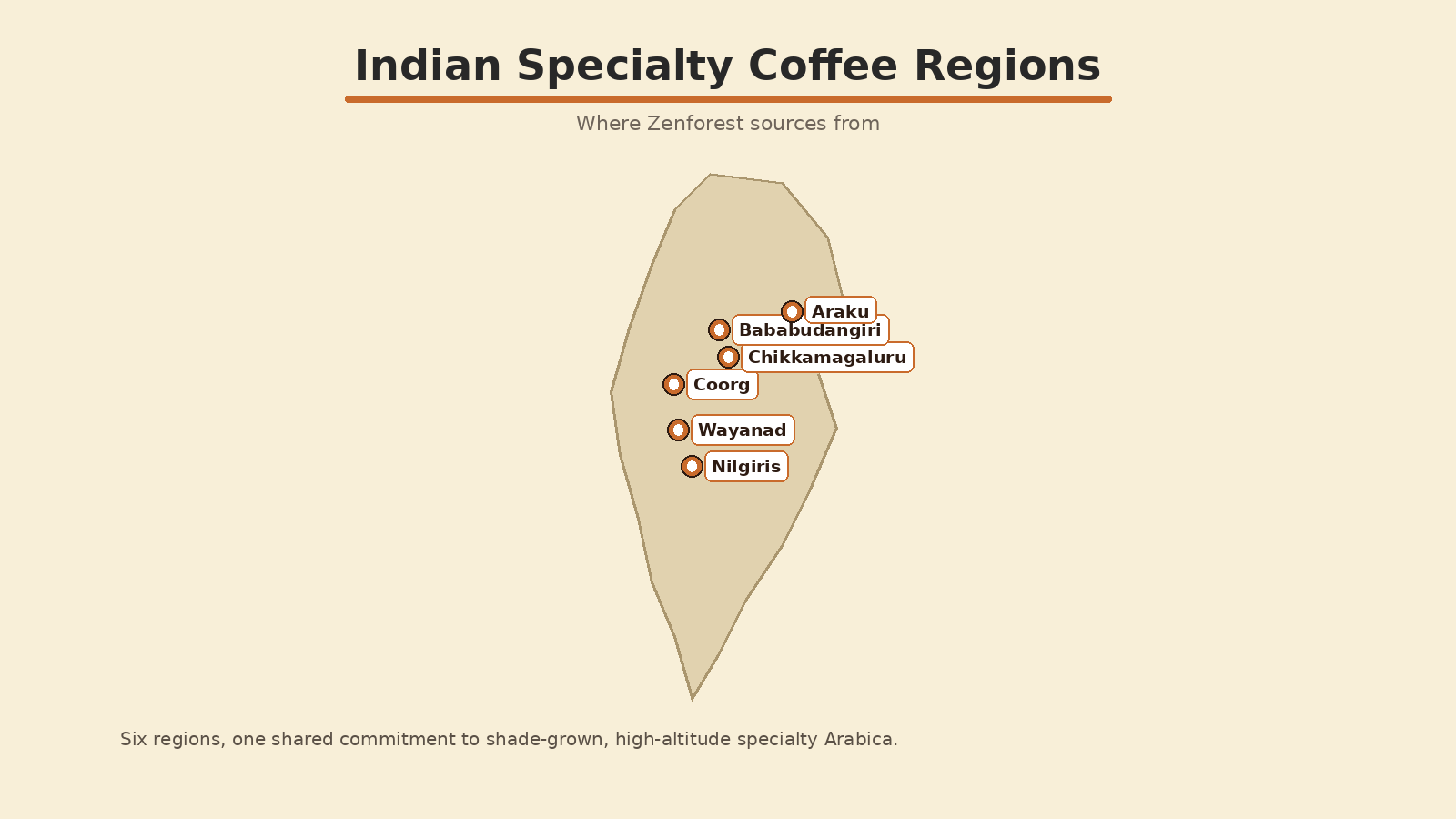
India's main coffee-growing regions are concentrated in Karnataka (Coorg, Chikmagalur, Baba Budangiri), Kerala (Wayanad), Tamil Nadu (Nilgiris, Yercaud), and Andhra Pradesh (Araku Valley). Each produces a distinct flavour profile shaped by altitude, shade canopy, and processing tradition. Coorg is known for chocolate and spice; Chikmagalur for floral brightness; Araku for fruity acidity; Wayanad for bold Robusta body; and Monsooned Malabar for low acid, earthy richness unlike any other coffee in the world.
Key Takeaways
- Karnataka produces the majority of India's coffee across Coorg, Chikmagalur, and Baba Budangiri.
- Indian coffee is shade-grown under native forest canopy — a tradition that predates modern sustainability movements.
- Altitude is the single biggest driver of flavour difference between regions.
- Araku Valley is one of specialty coffee's most remarkable recent origin stories.
- Monsooning is unique to India's Malabar Coast and cannot be replicated anywhere else.
- Northeast India — Meghalaya, Nagaland, Mizoram — is emerging as the next growing frontier.
Why Indian Coffee is Different
Almost every major coffee-producing country grows its crop in full sun. India is the exception. Indian coffee — particularly in Karnataka, Kerala, and Tamil Nadu — is grown almost entirely under a native forest canopy, a tradition that dates back to the 17th century and continues to define the cup today.
Shade-Grown by Tradition, Not Trend
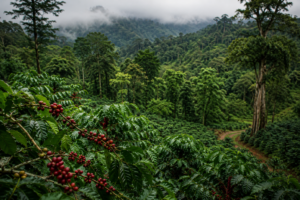
Coffee in India shares its growing space with rosewood, silver oak, jackfruit, and native rainforest trees. This isn't a recent sustainability initiative — it's how Indian coffee has always been farmed, long before "shade-grown" became a marketing term elsewhere. The result is a growing environment that naturally produces lower acidity, heavier body, and more nuanced sweetness than open-field coffee of equivalent origin.
Biodiversity and Wildlife Corridors
Indian coffee estates frequently sit inside or adjacent to elephant corridors and wildlife reserves. The multi-tier canopy of coffee, spice vines, and timber trees supports birds, insects, and larger mammals, making well-managed estates an extension of the forest rather than a replacement for it.
Spice Plantations, Not Monocultures
It's common to find pepper vines climbing the same trees that shade the coffee, along with cardamom, areca nut, and orange trees planted between rows. This intercropping is part of why Indian coffee often carries subtle spice notes even before it reaches the roaster.
Monsoon-Driven Climate
Unlike origins with a single dry harvest season, Indian coffee farming is built around the southwest monsoon. Heavy, predictable rainfall between June and September is followed by a dry harvest window, and this rhythm directly shapes flowering, cherry development, and the unique monsooning process found nowhere else in the world.
Slower Ripening, Richer Sugars
The combination of shade and elevation slows down how quickly cherries ripen. Slower ripening allows more time for sugars to develop within the cherry, which is part of why well-grown Indian Arabica can show a natural sweetness that fast-ripened, sun-grown coffee often lacks. The science behind this is covered in full in our Specialty Coffee 101 Guide.
Indian Coffee Industry at a Glance
| Statistic | Value |
|---|---|
| Coffee-Growing States | 13 states across South and Northeast India |
| Major Producing States | Karnataka, Kerala, Tamil Nadu |
| Arabica Share | Roughly 30% of national production |
| Robusta Share | Roughly 70% of national production |
| Export Share | The majority of Indian coffee is exported, largely to Europe |
| Domestic Consumption | A smaller but steadily growing share, led by the specialty coffee movement |
| Shade-Grown Coverage | The vast majority of Indian estates use multi-tier native shade |
Figures are representative industry approximations and vary year to year with harvest conditions.
Karnataka: The Heart of Indian Coffee
Karnataka produces the majority of India's coffee and is home to its two most recognised specialty origins — Coorg and Chikmagalur — along with the historic birthplace of Indian coffee itself, Baba Budangiri. Together, these districts form a continuous belt of coffee-growing hills along the state's western edge, each shaped by slightly different elevation, rainfall, and farming history despite their geographic proximity.
Coorg (Kodagu)
History
Coorg, also known as Kodagu, is India's largest coffee-producing district. Coffee cultivation here dates back generations, with estates often passed down through families alongside cardamom and pepper farming on the same land.
Altitude
Estates in Coorg typically sit between 900 and 1,300 metres above sea level, with the higher pockets producing noticeably denser, more complex beans.
Rainfall
Coorg receives some of the heaviest monsoon rainfall in Karnataka, often exceeding 2,500mm annually — ideal for both coffee and the spice crops grown alongside it.
Soil
Rich, well-draining lateritic and forest loam soils, built up over generations of leaf litter from the native shade canopy.
Shade Trees
Silver oak, rosewood, and jackfruit are common, alongside pepper vines trained up the same trunks.
Processing
Both washed and natural processing are common in Coorg, with washed lots being the more traditional, widely available style.
Flavour Profile
Coorg coffee is known for notes of dark chocolate, mild spice, and a rounded, medium body — a profile shaped directly by the pepper and cardamom grown alongside it. To understand how these notes form, see our Coffee Flavour Notes guide.
Best Brewing Methods
Its chocolatey, low-to-medium acidity profile makes Coorg coffee well suited to drip, French press, and espresso, where its body and roundness come through clearly.
Explore our Coorg Highlands Coffee, grown under native shade canopy in the heart of Kodagu.
Chikmagalur
History
Chikmagalur is widely considered the birthplace of Indian coffee cultivation on a commercial scale, with estates dating back over a century.
Altitude
Many Chikmagalur estates sit higher than Coorg, often between 1,000 and 1,500 metres, contributing to brighter acidity in the cup.
Rainfall and Soil
Moderate-to-heavy monsoon rainfall combined with well-drained, mineral-rich hillside soils supports slow, even cherry development.
Shade Trees
A mix of native rainforest species and silver oak, often denser and taller than the canopy found in lower-altitude Coorg estates.
Processing
Washed processing is the dominant style here, prized for preserving the brighter, floral character the altitude produces.
Flavour Profile
Expect a lighter body than Coorg, with floral aromatics, citrus-toned acidity, and a clean, tea-like finish — a profile that rewards attention to brew temperature and extraction care.
Best Brewing Methods
This brighter profile shines in pour-over, V60, or AeroPress, where its acidity and aromatics aren't muted by a heavier brew method.
Baba Budangiri
Baba Budangiri holds a unique place in coffee history. Legend credits a 17th-century Sufi saint, Baba Budan, with smuggling seven coffee seeds out of Yemen and planting them in these hills — the origin point of coffee cultivation in India.
Today, the high-altitude slopes of Baba Budangiri, often reaching above 1,300 metres, produce small, low-yield lots of exceptional Arabica. The combination of altitude, age-old shade forest, and limited production makes this one of the most sought-after micro-origins in the country, with a cup character that's often more concentrated and complex than coffee from the surrounding lowlands.
Hassan
Hassan district, neighbouring Chikmagalur, produces solid mid-altitude Arabica and Robusta with a milder, more everyday-drinking profile — less internationally recognised, but an important contributor to Karnataka's overall volume.
Kerala
Wayanad
Wayanad is Kerala's coffee heartland and one of the largest Robusta-growing regions in India, accounting for a substantial share of the state's total production. Unlike the higher, cooler estates of Karnataka, Wayanad's lower elevation and warmer, humid climate are particularly well suited to Robusta, which thrives at altitudes where Arabica would struggle to develop properly.
Shade and Canopy
Wayanad estates are typically farmed under a dense, multi-layered native canopy — a continuation of the broader Western Ghats shade-grown tradition. This thick cover, combined with the region's heavy monsoon rainfall, keeps humidity high and supports slow, even cherry development even at lower elevation.
Robusta at Scale
Robusta from Wayanad is known for its bold body, low acidity, and earthy, almost nutty depth, making it a favourite base for espresso blends and milk-based drinks where a lighter Arabica would get lost.
Pepper Intercropping
The intercropping with black pepper is especially pronounced in Wayanad, with pepper vines trained up shade trees throughout the estates. This close-quarters farming often gives the coffee a subtle, naturally spiced undertone.
Nelliyampathy
A smaller, high-altitude pocket in Kerala's Palakkad district, Nelliyampathy sits in stark contrast to the lower-lying Robusta belt of Wayanad. Its steep, forested slopes and cooler climate make it suitable for limited Arabica cultivation. A handful of estates here have begun experimenting with specialty-grade processing, and Nelliyampathy is increasingly mentioned alongside other up-and-coming Kerala micro-origins worth watching.
Tamil Nadu
Nilgiris
The Nilgiri hills, known globally for tea, also support a smaller but meaningful coffee industry at elevations that rival Chikmagalur. Coffee here is often grown in plots interspersed with the region's far larger tea estates, sharing the same cool, misty conditions that make Nilgiri tea distinctive.
Nilgiri coffee tends toward bright acidity and a clean, crisp cup, with the high altitude and consistent cloud cover producing a slower, more even ripening cycle. Because tea has historically dominated the region's economy and export identity, Nilgiri coffee remains comparatively under-recognised — but its growing conditions are, on paper, very similar to those that make Chikmagalur so prized.
Shevaroys (Yercaud)
A compact coffee-growing pocket around the hill town of Yercaud, the Shevaroy hills produce small volumes of both Arabica and Robusta across a patchwork of mid-sized estates. Coffee tourism has become an increasingly important part of the local economy, with several Yercaud estates opening their farms to visitors during harvest season.
Pulneys (Kodaikanal)
Surrounding the hill station of Kodaikanal, the Pulney hills are another smaller, high-altitude growing area contributing to Tamil Nadu's overall but modest share of national coffee production. Cultivation here tends to be small-scale and family-run, often intercropped with fruit orchards and spices rather than farmed as dedicated coffee monocultures.
Andhra Pradesh
Araku Valley
Araku Valley is one of the most remarkable stories in Indian coffee. Grown in the Eastern Ghats by indigenous tribal farming communities, Araku coffee has gone from a largely unknown regional crop to an internationally awarded specialty origin within a generation.
Tribal Farmers
Coffee in Araku is cultivated almost entirely by tribal smallholder farmers, often organised into cooperatives that handle collective processing and quality control — a structure that has been central to the region's rapid quality gains.
Organic by Practice
Much of Araku's coffee is grown without synthetic fertilisers or pesticides, a practice rooted in traditional tribal farming methods rather than a retrofitted certification push.
High Altitude
Araku's coffee is grown at elevations often exceeding 900–1,100 metres in the Eastern Ghats, contributing to a fruit-forward, tangy acidity that distinguishes it sharply from Western Ghats coffee.
International Recognition
Araku coffee has earned recognition at international coffee competitions over the past decade, helping put a previously overlooked region on the global specialty map. The shift toward cooperative processing, quality control, and direct relationships with buyers has been central to that change.
A Model for Origin Development
Araku is frequently cited as a case study in how cooperative-driven, farmer-first development can transform a region's quality and market position quickly. Rather than large estates driving change, it's been smallholder tribal farmers pooling resources for processing and grading that previously only large operations could afford. The result is a cup that's distinctly different from Karnataka or Kerala coffee — typically brighter, fruitier, and slightly tangy, closer in character to some East African origins than to its fellow Indian regions.
Odisha
Odisha's coffee industry is small but growing, concentrated in the tribal belts of the Eastern Ghats — geographically and culturally not unlike Araku just across the border in Andhra Pradesh. Districts such as Koraput have become the focal point of cultivation efforts, supported by state agricultural programs aimed at giving tribal farmers a higher-value alternative crop.
If the cooperative model continues to mature here as it has in Araku, Odisha could become a meaningful contributor to India's Eastern Ghats coffee story over the next decade.
Emerging Regions: Northeast India
A handful of Northeast Indian states are quietly emerging as the next frontier for Indian specialty coffee, supported by favourable elevation, rainfall, and government-backed cultivation programs.
Meghalaya
Garo and Khasi hill farmers are increasingly planting Arabica at altitude. Meghalaya's heavy rainfall combined with cool hill temperatures creates conditions not unlike the higher estates of Chikmagalur. Early specialty-grade lots have begun drawing attention from roasters looking to diversify beyond the established Western Ghats origins.
Nagaland
Government-supported coffee programs are expanding cultivation across Naga hill villages. High elevation across much of the state offers strong long-term potential for Arabica specifically, though the industry here is still building out processing infrastructure.
Mizoram
State agricultural departments are running demonstration farms to assess yield and quality before wider rollout. Production remains in early stages, with most current output used for local consumption and small-batch trials.
Arunachal Pradesh
The state's high-altitude terrain is being explored for future specialty coffee cultivation. Limited infrastructure has slowed development so far, but the elevation and climate profile position Arunachal Pradesh as one of India's most promising long-term growing regions.
Altitude and Terroir
Altitude is one of the single biggest drivers of flavour difference between Indian coffee regions — arguably more influential than the state or district a coffee comes from. Two estates a hundred kilometres apart can taste more similar to each other than two estates on the same hillside at very different elevations.
| Altitude | Typical Cup Characteristics |
|---|---|
| 800 m | Soft acidity, fuller body, mellow and approachable |
| 1,000 m | Balanced acidity and body, rounded sweetness |
| 1,200 m | Brighter acidity, more defined aromatics, medium body |
| 1,500 m | Pronounced acidity, floral or fruit-forward complexity, denser bean structure |
Higher elevations slow down cherry ripening due to cooler temperatures, giving the bean more time to develop sugars and organic acids before harvest. This is why high-altitude micro-origins like Baba Budangiri and the upper estates of Chikmagalur are so consistently prized by specialty buyers, often commanding a price premium over lower-altitude lots of the same variety.
It's worth noting that altitude alone doesn't guarantee quality — soil health, shade management, and processing care all matter just as much. But all else being equal, altitude remains the most reliable single predictor of acidity and complexity in an Indian coffee's cup profile.
Arabica vs Robusta Across India
| Trait | Arabica | Robusta |
|---|---|---|
| Acidity | Higher, brighter, often fruity or floral | Lower, flatter, more neutral |
| Sweetness | More pronounced natural sweetness | Less sweetness, more bitterness |
| Body | Light to medium | Heavy, fuller-bodied |
| Preferred Altitude | 1,000 m and above | Below 1,000 m |
| Caffeine Content | Lower (roughly half of Robusta) | Higher, more bitter at equal strength |
India is one of the few major origins that grows substantial volumes of both species at scale — Arabica dominating the higher-altitude Karnataka and Tamil Nadu estates, Robusta thriving in Kerala's lower, wetter regions like Wayanad. See the full breakdown in our Arabica vs Robusta guide.
Shade-Grown Coffee
This is one of the strongest differentiators of Indian coffee, and it's central to how Zenforest farms.
Native Canopy
Multi-tier shade — combining tall timber trees, mid-level fruit trees, and lower shrub layers — mimics a natural forest structure rather than a single-species farm.
Birds and Insects
This layered canopy supports far more bird and insect biodiversity than open, sun-grown plantations, with many estates functioning as informal wildlife habitat.
Elephants and Wildlife Corridors
In Karnataka and Kerala particularly, shade-grown coffee estates often border or sit within elephant corridors, allowing wildlife movement that monoculture farming would otherwise block.
Slower Ripening, Richer Sugars
Shade slows the ripening process, giving cherries more time to develop sugar content — a key reason shade-grown coffee is often described as having a rounder, sweeter cup. This is the same mechanism that makes honey-processed coffees taste sweeter than washed equivalents: extended contact with sugar sources during development.
Processing Traditions
Indian coffee uses the full range of global processing styles, plus one method unique to the subcontinent. Processing choice often varies more by estate and ambition than by region — a single district can be home to estates still using traditional sun-drying patios alongside neighbours experimenting with anaerobic fermentation tanks. See the full breakdown in our Coffee Processing Methods Guide.
Washed
The most common method across Karnataka, producing a clean, defined cup that lets regional terroir come through clearly without fermentation flavours masking it.
Natural
Increasingly used by specialty-focused estates to produce bolder, fruit-forward lots, particularly in Coorg and Araku, where the warmer climate suits sun-drying whole cherries.
Honey
A smaller but growing category among experimental Indian producers, balancing sweetness with moderate acidity. See our full Honey Process Coffee Guide for how this works.
Anaerobic
Found on a handful of forward-thinking estates pushing into bold, fermentation-driven flavour profiles, often as small experimental micro-lots rather than full-scale production runs.
Monsooned
India's signature process — beans exposed to monsoon winds along the Malabar coast over several weeks, stripping natural acidity and building a full-bodied, earthy cup found in Monsooned Malabar. This style can't be replicated anywhere India's specific coastal monsoon pattern doesn't exist.
Barrel Aged
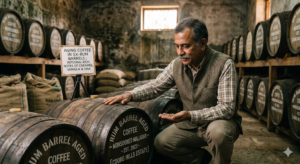
A newer, limited-batch style where processed beans rest in spirit barrels, picking up subtle wood and spirit-derived notes. Our Rum Barrel Aged Coffee and Cinnamon Fermented Coffee are the clearest expressions of this direction.
Which Region Should You Choose?
| You Like... | Choose |
|---|---|
| Chocolate and spice notes | Coorg |
| Floral, brighter cups | Chikmagalur |
| Fruity, wine-like acidity | Araku Valley |
| Low acidity, earthy depth | Monsooned Malabar |
| Bold, full-bodied espresso | Wayanad Robusta |
| Experimental barrel or fermentation character | Rum Barrel Aged / Cinnamon Fermented |
If you'd like to taste the Baba Budangiri profile, our Wildwood Spice draws on coffee from this micro-origin, while drinkers chasing something more experimental should look at Bourbon Bliss.
The fastest way to understand Indian regional differences is to taste Coorg and Chikmagalur side by side — same country, same shade-grown tradition, very different cups. Coorg will be rounder and more chocolatey; Chikmagalur will be lighter and more floral. That single comparison teaches you more about how altitude and soil shape flavour notes than reading any amount of origin information alone.
Common Mistakes
Continue Learning
Recommended Coffees
Start With Karnataka
India's Unique Processing Styles
Experimental Range
Learn More
Frequently Asked Questions
Which Indian state produces the most coffee?
Karnataka is India's largest coffee-producing state by a wide margin, accounting for the majority of national output, followed by Kerala and Tamil Nadu. Within Karnataka, Kodagu (Coorg), Chikmagalur, and Hassan districts together make up the bulk of that production.
Which Indian coffee region is best?
There's no single "best" region — it depends on what you're looking for. Coorg suits chocolate and spice lovers, Chikmagalur suits those who want floral brightness, and Araku suits drinkers chasing fruity, wine-like acidity. The "best" region is the one that matches your preferred flavour profile and brew method.
What is Coorg coffee?
Coorg coffee comes from Kodagu district in Karnataka, India's largest coffee-growing region, typically grown under shade alongside pepper and cardamom, producing a chocolatey, medium-bodied cup with mild spice notes.
Is Araku coffee organic?
Much of Araku's coffee is grown using traditional tribal farming methods without synthetic fertilisers or pesticides, though not all of it carries formal organic certification — certification involves a separate, often costly process that many smallholder cooperatives are still working toward.
Which Indian coffee has the least acidity?
Monsooned Malabar is well known for its exceptionally low acidity, a result of the unique monsoon-exposure process that mellows the bean's natural sharpness over several weeks of controlled humidity exposure.
Which Indian coffee is best for espresso?
Robusta from Wayanad in Kerala is a popular choice for espresso, prized for its bold body and low acidity. For a single-origin Arabica espresso, our Coorg Highlands or Monsoon Malabar are strong choices.
Why is Indian coffee shade-grown?
Shade-growing is a long-standing tradition in Indian coffee farming, originally developed to protect plants from harsh sun, and has since proven to support biodiversity, slow cherry ripening, and improve flavour development — making it as much a quality choice today as a historical one.
Does India produce specialty coffee?
Yes. India's specialty coffee movement has grown significantly over the past two decades, with regions like Chikmagalur, Baba Budangiri, and Araku Valley producing internationally competitive, high-scoring lots that hold their own against more famous global origins. See our Specialty Coffee 101 Guide for how specialty grading works.
India's Coffee Story is Still Being Written
From the historic slopes of Baba Budangiri to the tribal farms of Araku Valley and the emerging hills of Meghalaya, India's coffee-growing regions are far more diverse than most drinkers realise. Understanding where your coffee comes from — its altitude, its shade canopy, its processing tradition — changes how you taste every cup.
The Western Ghats gave the world Monsooned Malabar and centuries of shade-grown tradition. The Eastern Ghats are producing some of the most exciting new specialty lots in Asia. And the Northeast is still revealing what it's capable of. There's no other country where the coffee story is developing on this many fronts simultaneously.
Taste India's Regions, One Cup at a Time
Explore our carefully sourced, fully transparent specialty collection grown in harmony with the ecosystems of the Western Ghats — from classic Coorg chocolate to experimental barrel-aged lots.
Shop Our Specialty Collection →