
Roast level is one of the biggest factors influencing how coffee tastes. Whether you prefer bright, fruity coffees or rich chocolatey cups, understanding light, medium, and dark roasts helps you choose beans that suit your palate. In this guide, we’ll explain what each roast level means, how roasting changes coffee, and how to pick the right roast for your brewing method.
Quick Answer: Light vs Medium vs Dark
Light Roast
- Bright
- Fruity
- Floral
- Higher perceived acidity
Medium Roast
- Balanced
- Sweet
- Chocolate
- Caramel
Dark Roast
- Bold
- Smoky
- Heavy body
- Low perceived acidity
What is Coffee Roasting?
Coffee roasting is the controlled application of heat that transforms green, grassy-tasting coffee seeds into the aromatic brown beans used for brewing. Every flavour you associate with coffee — chocolate, caramel, fruit, smoke — is created or unlocked during this single, carefully managed process.
Green Coffee
Before roasting, coffee is pale green, dense, and tastes nothing like coffee — closer to grass or raw legumes. All of its eventual flavour potential exists only as a starting point of sugars, acids, and proteins waiting to be transformed by heat.
Heat
Roasters apply heat gradually and precisely, typically over 8 to 15 minutes, tracking bean temperature continuously to control exactly how fast and how far the chemical transformation goes.
Maillard Reaction
Named after the chemist who first described it, the Maillard reaction is the browning reaction between amino acids and sugars that creates much of coffee’s complex aroma and flavour, the same reaction responsible for the flavour of seared meat or toasted bread.
Caramelization
As roasting continues, sugars begin to caramelize, breaking down and recombining into the sweet, toasty, slightly bitter compounds that build body and richness as roast level increases.
Development Time
The period after first crack, called development time, is where roasters make their most consequential decisions — a few extra seconds here can shift a coffee from bright and tea-like to rounded and syrupy.
What Happens During Roasting?
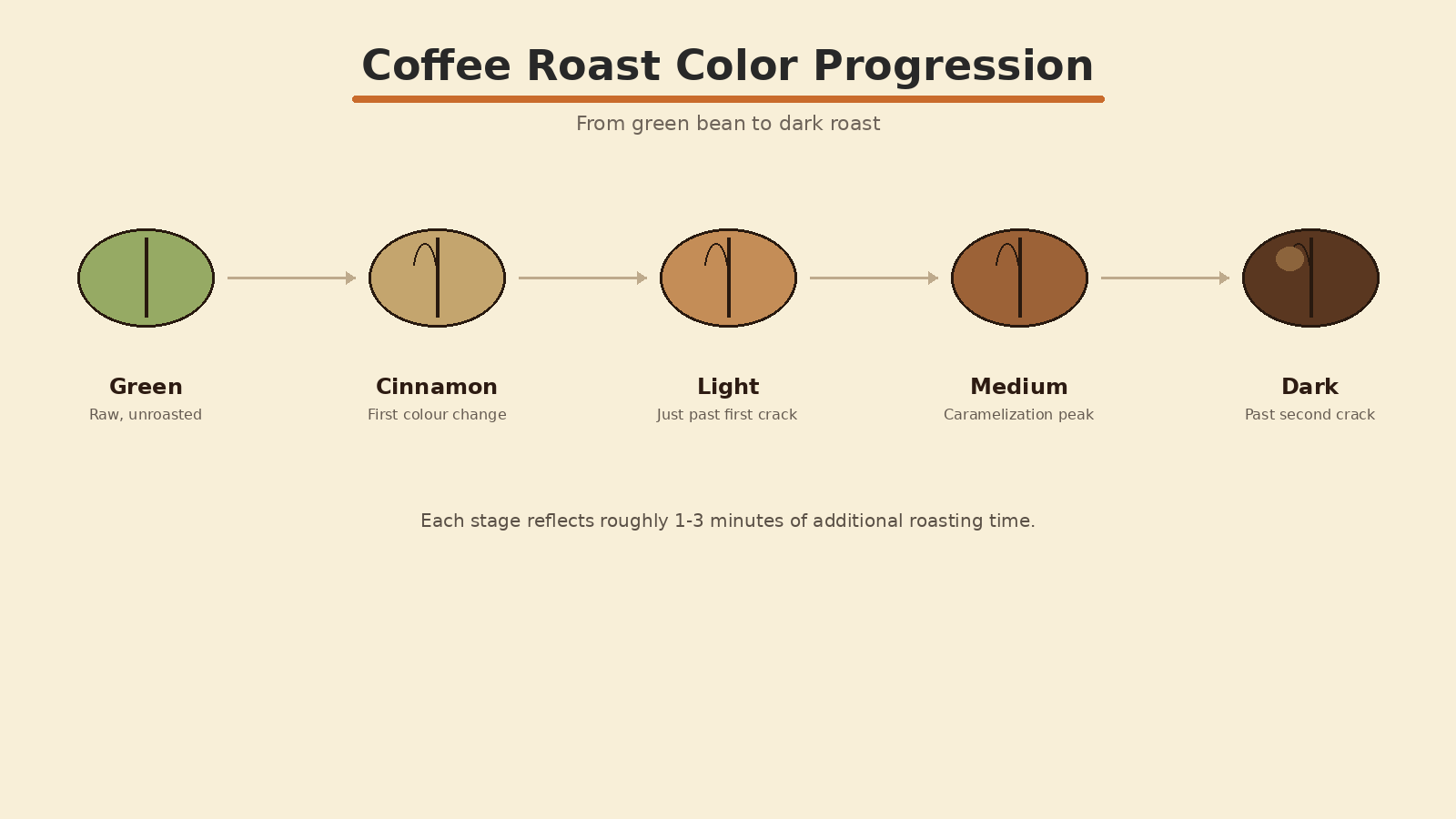
Roasting isn’t just a color change — it’s a cascade of physical and chemical transformations happening in a matter of minutes.
Water Evaporation
Green coffee holds roughly 10-12% moisture, almost all of which evaporates in the first several minutes of roasting, a stage that consumes a large share of the total roast energy before any browning even begins.
Expansion
As internal moisture turns to steam, the bean’s cellular structure expands and becomes more porous, which is why roasted beans are visibly larger and lighter than the dense green seeds they started as.
CO₂ Formation
Roasting generates carbon dioxide trapped inside the bean’s cell structure, which continues slowly releasing for days afterward — the reason freshly roasted coffee needs a short resting period before brewing.
Oils
As roasting progresses, oils migrate from inside the bean toward the surface, becoming visibly glossy in darker roasts as cell walls break down and can no longer contain them.
Aroma Compounds
Hundreds of distinct aromatic compounds form during roasting, peaking in complexity at different points along the roast curve — part of why roast level so dramatically reshapes a coffee’s smell and taste.
First Crack vs Second Crack
Two audible cracking sounds mark the most important checkpoints in any roast, giving roasters a reliable real-time signal of where a batch sits on the roast curve.
First Crack
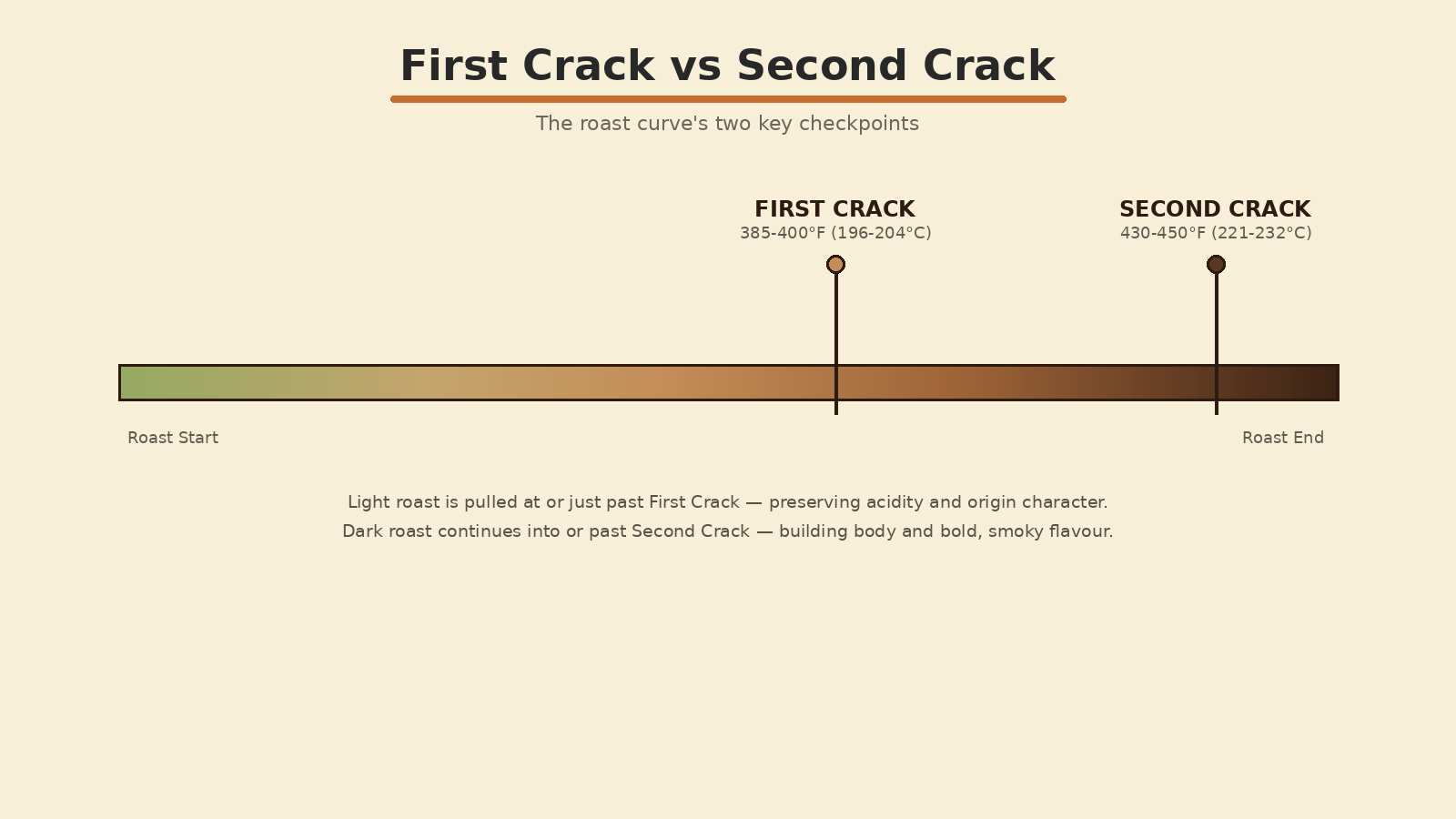
Occurring at roughly 385–400°F (196–204°C), first crack is the sound of internal steam pressure physically fracturing the bean’s structure, marking the earliest point a coffee is technically drinkable. This is where light roasts are pulled, preserving maximum acidity and origin character. First crack matters because it’s the universal reference point roasters use to time everything that follows — development time is measured from this moment forward.
Second Crack
Occurring at roughly 430–450°F (221–232°C), second crack is a sharper, quieter crackling caused by the bean’s cell walls fracturing further as oils are forced to the surface. This is where dark roasts begin, as caramelization gives way to the early stages of carbonization. Second crack matters because it marks the point where roast-driven flavour — smoke, char, heavy body — begins to dominate over origin character.
Light Roast Coffee
Temperature
Light roasts are pulled shortly after first crack, generally between 196–205°C, stopping the roast before significant caramelization develops.
Appearance
Light roast beans are a pale cinnamon-brown with a dry, matte surface and no visible oil sheen.
Density
Because roasting time is shorter, light roast beans retain more of their original mass and density than darker roasts, which is part of why they require a slightly different dose when brewing.
Acidity
Acidity is at its most pronounced in light roasts, giving the cup a bright, lively, sometimes citrus-like character that fades progressively as roast level increases.
Sweetness
Sweetness in light roasts comes through as delicate and fruit-driven rather than the deep caramel sweetness of darker roasts — think berry or stone fruit sugars rather than toffee.
Body
Light roasts have the lightest body of the three levels, often described as tea-like or silky rather than thick or syrupy.
Best Brewing Methods
Pour-over methods like V60 and Chemex are ideal for light roasts, since their clean extraction style highlights the acidity and origin character these roasts are built to showcase.
Best For
Drinkers who want to taste a coffee’s specific origin, variety, and processing method clearly — light roast is the truest expression of where a coffee actually came from.
Medium Roast Coffee
Temperature
Medium roasts develop further past first crack, typically reaching 205–220°C, allowing more time for caramelization to round out the cup.
Appearance
Medium roast beans are a richer, even brown with a dry to slightly satin surface, occasionally showing the faintest trace of oil.
Sweetness
This is where caramelization peaks most favorably — medium roasts often deliver the sweetest cup of the three levels, with caramel and brown sugar notes layered over the bean’s natural sugars.
Body
Body thickens noticeably compared to light roast, landing in a comfortable middle ground that feels substantial without becoming heavy.
Balance
Medium roast is prized specifically for balance — acidity, sweetness, and body sit closer to equal weight here than at either extreme, which is why it remains the most popular roast level worldwide.
Brewing
Medium roast is the most forgiving and versatile roast level, performing well across nearly every brewing method from French press to drip to AeroPress.
Zenforest Coffees
Dark Roast Coffee
Second Crack
Dark roasts are taken into or just past second crack, where caramelization gives way to the beginning stages of carbonization, producing the bold, smoky character dark roast is known for.
Oils
The visible sheen on dark roast beans comes from oils forced to the surface as the bean’s internal structure breaks down under extended heat — a natural result of the roast level, not a defect.
Body
Dark roast carries the heaviest body of the three levels, often described as thick, syrupy, or full, which is part of why it performs so well in espresso and milk-based drinks.
Chocolate Notes
Deep cocoa, dark chocolate, and roasted nut notes dominate dark roast, with origin-specific fruit or floral notes almost entirely roasted away by this point.
Milk Drinks
Dark roast’s bold, low-acid profile is built to cut through milk rather than get lost in it, which is why it’s been the traditional default for lattes and cappuccinos for decades.
Zenforest House Blend
Roast Level Comparison Table
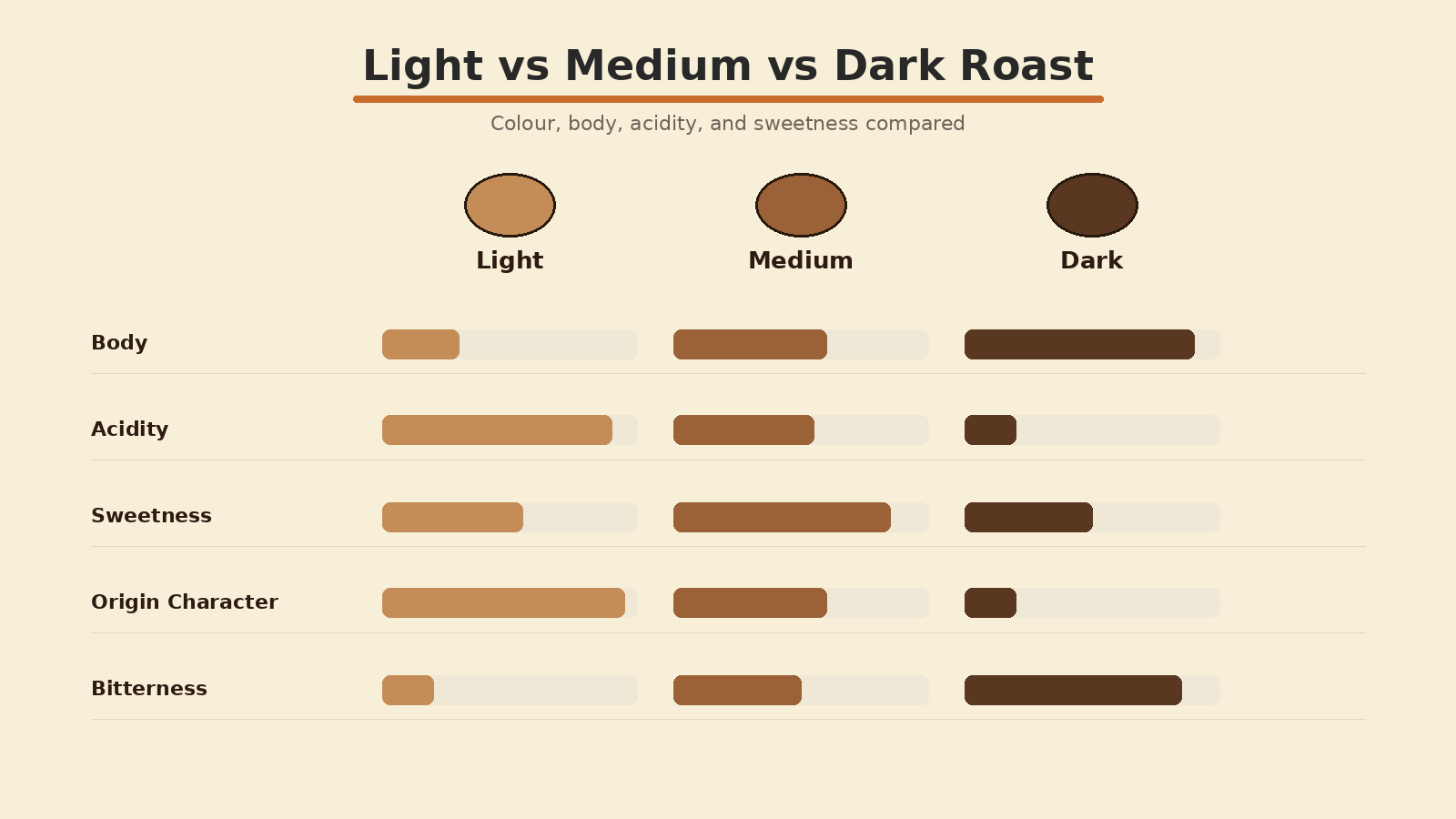
| Feature | Light | Medium | Dark |
|---|---|---|---|
| Colour | Light Brown | Brown | Dark Brown |
| Oils | None | Slight | Visible |
| Body | Light | Medium | Heavy |
| Acidity | High | Medium | Low |
| Sweetness | Medium | High | Medium |
| Origin Character | Very High | High | Low |
| Bitterness | Low | Medium | High |
| Best Brewing | Pour Over | All | Espresso |
Roast Temperature Chart
| Roast | Temperature |
|---|---|
| Cinnamon | 196°C |
| Light | 196–205°C |
| Medium | 205–220°C |
| Dark | 220–230°C |
Which Roast Preserves Origin Best?
Light roast preserves origin character more faithfully than any other roast level, which is exactly why specialty roasters lean toward it for their highest-quality lots.
Terroir
Soil composition, microclimate, and surrounding vegetation all leave a fingerprint on a coffee’s flavour — a fingerprint that’s far easier to taste in a lightly roasted cup than one pushed into heavy caramelization.
Altitude
High-altitude coffees develop more complex acids and sugars during slower cherry ripening, and light roasting is what allows that complexity to actually reach the cup instead of being roasted over.
Variety
Different coffee varieties carry distinct genetic flavour signatures — Bourbon’s sweetness, Gesha’s florality — and light roasting is what keeps those signatures recognizable rather than uniform.
Processing
The entire point of distinguishing washed, natural, and honey processing collapses at darker roast levels, since heavy roasting flattens the very differences those methods are designed to create. See our full Coffee Processing Guide for how each method shapes flavour before roasting even begins.
Why Specialty Roasters Roast Lighter
Specialty roasters roast lighter specifically because the entire value of paying a premium for traceable, high-altitude, carefully processed coffee is lost if it’s roasted dark enough to taste the same as every other dark roast on the shelf. For more on how origin shapes flavour from the ground up, see our Indian Coffee Regions Guide.
Which Roast is Best for Different Brewing Methods?
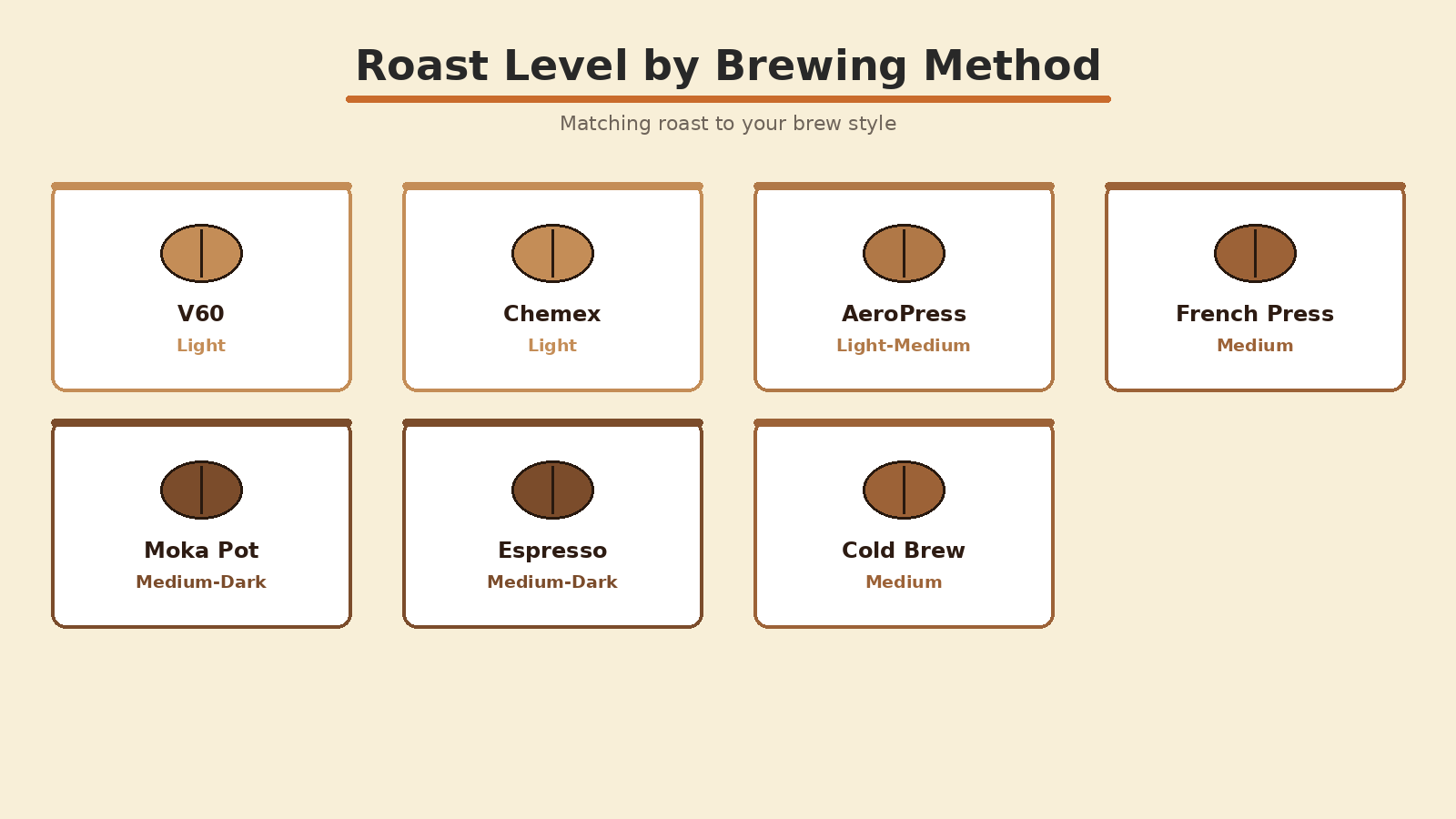
| Brewing Method | Best Roast |
|---|---|
| V60 | Light |
| Chemex | Light |
| AeroPress | Light-Medium |
| French Press | Medium |
| Moka Pot | Medium-Dark |
| Espresso | Medium-Dark |
| Cold Brew | Medium |
Which Roast Goes Best with Milk?
Milk-based drinks generally pair better with bolder roasts, since milk’s sweetness and fat content can easily mute a lighter roast’s more delicate acidity.
Flat White
A medium-dark roast works best here, strong enough to come through against the higher ratio of milk to espresso that defines this drink.
Latte
Dark or medium-dark roast holds up best against a latte’s larger milk volume, ensuring the coffee flavour doesn’t disappear entirely.
Cappuccino
Medium-dark roast balances well against cappuccino’s foam-heavy texture, providing enough body to stand out under the airy milk.
Cortado
With a lower milk ratio than a latte, a cortado has more room for a medium roast to come through, offering a slightly brighter alternative to the typical dark roast default.
As a general rule, medium to dark roast is the safer recommendation across most milk drinks, simply because bolder roast character is more likely to survive dilution.
Which Roast Has More Caffeine?
This is one of the most persistent myths in coffee, and the honest answer depends entirely on how you’re measuring.
By Weight
Caffeine content by weight is essentially the same across light, medium, and dark roast — roasting does not meaningfully burn off caffeine, contrary to popular belief.
By Volume
Because light roast beans are denser and lose less mass during roasting, a scoop measured by volume actually contains slightly more beans, and therefore slightly more caffeine, than the same scoop of a less dense dark roast.
Why This Myth Exists
The myth that dark roast has more caffeine likely persists because dark roast tastes stronger and more bitter, and people naturally associate bolder flavour with a bigger caffeine hit — even though taste intensity and caffeine content aren’t actually linked.
Common Roast Myths
How to Choose Your Roast
How Zenforest Chooses Roast Profiles
We don’t apply one roast curve across every coffee — each lot earns its own profile based on what the green coffee itself is telling us.
Cupping
Every new lot is cupped at multiple roast levels before we commit to a production profile, letting us taste directly how a coffee responds to lighter versus darker development.
Sample Roasting
Small sample batches are roasted first to map out how a specific lot behaves on the roast curve, since beans from different farms — even the same variety — can roast quite differently.
Density
Denser beans, typically grown at higher altitude, absorb heat differently than less dense beans, and our roast curves are adjusted accordingly to avoid scorching the exterior before the interior develops.
Moisture
Green coffee moisture content shifts seasonally even from the same farm, so we re-check and recalibrate roast profiles regularly rather than assuming last season’s curve still applies.
Processing
Natural and honey-processed lots carry more sugar density than washed coffee and require a gentler approach to avoid scorching that sugar during roasting, while washed lots can typically handle a slightly faster curve.
Roast Curves
The final roast curve — the rate of temperature rise from charge to drop — is tuned specifically to each lot’s density, moisture, and processing method, rather than applied as a one-size-fits-all template.
Frequently Asked Questions
Which roast is healthiest?
All roast levels offer similar core health benefits and antioxidant content — differences are minor and roast level shouldn’t be a primary health consideration either way.
Which roast has more caffeine?
By weight, they’re essentially equal. By volume, light roast can be marginally higher since denser beans pack slightly more mass into the same scoop.
Which roast is best for beginners?
Medium roast is usually the easiest starting point, offering a balanced, approachable profile that isn’t as polarizing as the extremes of light or dark.
Which roast is best for espresso?
Medium-dark is the traditional choice for body and crema, though many specialty cafés now pull espresso from lighter roasts for more clarity and sweetness.
Which roast is least acidic?
Dark roast has the lowest perceived acidity, as extended roasting breaks down much of the acid structure that gives lighter roasts their brightness.
Which roast tastes sweetest?
Medium roast typically tastes sweetest, landing at the point where caramelization peaks before bitterness from further roasting starts to take over.
Which roast is fruity?
Light roast preserves the most fruit-forward character, especially in naturally or honey-processed coffees where fruit notes are already pronounced before roasting.
Does roast affect caffeine?
Only marginally, and mainly by volume rather than weight — roasting does not meaningfully burn off caffeine content.
Why is dark roast oily?
Extended roasting breaks down the bean’s cell walls, allowing internal oils to migrate to the surface, which is why darker roasts develop a visible sheen that lighter roasts don’t.
Can I use light roast in espresso?
Yes. It’s increasingly common in specialty cafés, producing a brighter, more acidic, fruit-forward shot rather than the traditional bold, heavy-bodied style.
Which roast lasts longer?
Light roast generally holds its freshness slightly longer, since dark roast’s more porous, oil-exposed surface is more vulnerable to oxidation over time.
Which roast is best for pour over?
Light roast is the standard recommendation, since pour-over’s clean extraction style is specifically suited to highlighting acidity and origin character.
What’s the difference between medium and medium-dark roast?
Medium-dark sits just past standard medium, with a touch more caramelization and the first hints of oil on the surface, bridging the balance of medium roast with some of dark roast’s added body.
Does roast level change from bean to bean?
Yes. The same target roast level can require different time and temperature curves depending on the bean’s density, moisture, and processing method.
Is one roast level objectively better than the others?
No. Roast level is a matter of style and personal preference, not quality — the best roast is the one that matches what you actually enjoy drinking.
Continue Learning
Learn More
Find Your Roast
Love Fruity Coffees?
Love Balanced Coffees?
Love Bold Coffees?
Taste the Difference Roast Makes
From bright, fruit-forward light roasts to bold, syrupy dark roasts, explore our full range — each profile tuned to bring out exactly what that lot does best.
Shop Our Specialty Collection →