
India has been growing coffee since the 17th century — longer than most of the origins that dominate global specialty conversations today. Yet it remains one of the most underexplored origins among specialty coffee drinkers, partly because of historical positioning as a commodity exporter and partly because its profile simply doesn't resemble what most people expect from specialty coffee. Indian coffee is not bright and fruity. It is grounding, rich, and deeply satisfying — and it is unlike anything else in the world.
This guide is the complete picture: history, geography, the specific regions and what makes each distinct, the varieties grown, the shade-grown farming tradition, India's unique processing methods, and the small-farm cooperative model that is reshaping Indian specialty coffee's quality and identity.
Quick Answer
India produces specialty coffee almost exclusively under native forest canopy in the Western Ghats — a UNESCO World Heritage biodiversity hotspot. The result is a cup character defined by low acidity, heavy body, and deep chocolate, spice, and earth notes. India is also the only country that produces Monsoon Malabar, a uniquely processed coffee that cannot be replicated anywhere else in the world. Karnataka, Kerala, and Tamil Nadu are the main producing states; Araku Valley in Andhra Pradesh is the most exciting emerging specialty origin.
A Brief History of Indian Coffee
The story of Indian coffee begins with a Sufi saint named Baba Budan, who is said to have smuggled seven coffee seeds out of Yemen in the 17th century and planted them in the hills of Chikmagalur — becoming the origin point of coffee cultivation in India and, by extension, much of the world outside Arabia and Africa. Whether the story is fully historically accurate or not, the slopes of Baba Budangiri in Karnataka remain among the most revered micro-origins in Indian specialty coffee today.
Commercial coffee cultivation expanded under British colonial administration in the 19th century, particularly across the Western Ghats. By independence, India had established export infrastructure primarily serving European buyers who valued Indian coffee for its body and smoothness — characteristics shaped by the shade-grown growing environment and, in some cases, the distinctive monsoon processing that had developed from colonial-era sea transport.
Geography and the Coffee Belt
India's coffee-growing regions span three distinct geographic zones: the Western Ghats (Karnataka, Kerala, Tamil Nadu), the Eastern Ghats (Andhra Pradesh, Odisha), and the emerging northeastern hill states (Meghalaya, Nagaland, Mizoram). The Western Ghats account for the vast majority of current production and virtually all of India's established specialty reputation.
Coffee is cultivated across 13 Indian states, though Karnataka alone accounts for over 70% of national production. The crop grows between roughly 600m and 1,700m altitude, with higher elevations typically producing more acidic, complex Arabica and lower elevations better suited to Robusta.
The Western Ghats
The Western Ghats is a mountain range running roughly 1,600km along India's western coast. It is designated a UNESCO World Heritage Site and recognised by Conservation International as one of Earth's eight biodiversity hotspots — areas with exceptional concentrations of endemic species facing significant habitat threat. The Ghats intercept the southwest monsoon, producing some of the highest annual rainfall totals anywhere in the world (some estates receive 3,000–4,000mm per year) while the eastern slopes sit in the monsoon's rain shadow.
Coffee grown in the Western Ghats shares its ecosystem with elephants, leopards, hundreds of endemic bird species, and native tree varieties that predate the coffee cultivation by centuries. The shade canopy above the coffee plants isn't planted for sustainability branding — it's the original native forest, largely intact, into which coffee plants were introduced as an understorey crop.
Karnataka: Coorg and Chikmagalur
Karnataka is India's coffee heartland. Within Karnataka, two districts dominate specialty production:
Coorg (Kodagu)
India's largest coffee-producing district, known for estates that have grown coffee alongside pepper and cardamom for generations. Coorg coffee typically grows between 900m and 1,300m, producing a medium-bodied cup with chocolate, spice, and mild stone fruit notes. The pepper vines climbing the same shade trees as the coffee are part of why Coorg coffee carries natural spice character before the roaster adds anything.
Chikmagalur
Widely considered the birthplace of Indian commercial coffee cultivation. Higher elevation than Coorg — many estates at 1,000–1,500m — produces a brighter, lighter-bodied cup with more defined acidity and floral aromatics. Washed processing is dominant here, prized for preserving the altitude's contribution to cup character.
Baba Budangiri
A high-altitude micro-origin within Chikmagalur, historically significant and producing small volumes of exceptional Arabica from slopes that exceed 1,300m. Limited production, age-old shade forest, and genuine complexity make Baba Budangiri lots some of the most sought-after in Indian specialty coffee.
Kerala: Wayanad
Kerala's coffee heartland, Wayanad, sits at lower elevation than Karnataka's premier districts and is India's most significant Robusta-growing region. Wayanad Robusta is known for bold body, low acidity, and earthy nuttiness — a profile well-suited to espresso blends and milk-based drinks. The dense multi-tier shade canopy is a continuation of the Western Ghats tradition, and pepper intercropping is particularly pronounced here.
Tamil Nadu: Nilgiris
The Nilgiri hills — better known internationally for tea — support a smaller coffee industry that remains underrecognised despite growing conditions that rival Chikmagalur. High altitude, cool mist, and consistent cloud cover produce a clean, bright cup that has only recently begun attracting significant specialty attention. Coffee tourism around Yercaud and Kodaikanal is increasingly significant as smaller Nilgiri estates connect directly with consumers.
Araku Valley: The Remarkable Emergence
If there is one origin story in Indian coffee that deserves international attention equivalent to the best cooperative origin narratives from Africa or Latin America, it is Araku Valley. Located in the Eastern Ghats of Andhra Pradesh, Araku coffee is grown almost entirely by indigenous tribal smallholder farmers organised into cooperatives that collectively handle processing, drying, and quality control.
A generation ago, Araku coffee was sold as undifferentiated commodity. Today it has won awards at international specialty competitions and commands premium prices from European buyers who recognise its distinctly different profile — brighter, fruitier, and slightly tangy compared to Western Ghats coffee, closer in character to East African origins than to Coorg or Chikmagalur. This transformation was driven not by large estate investment but by collective tribal farmer organisation — a model worth studying for what it demonstrates about quality and market access.
Shade-Grown Farming
Almost all Indian coffee is shade-grown — not as a certified programme but as the default farming method that predates the specialty coffee movement by centuries. Native timber trees, fruit trees, spice crops, and the multi-tier canopy of a natural forest system surround the coffee plants on most estates. This creates several critical advantages: natural pest control from birds and insects supported by the biodiversity, consistent temperature and moisture regulation, organic matter cycling through leaf litter, and slower cherry ripening that allows sugar development over a longer period.
Varieties Grown in India
Indian Arabica production includes both internationally recognised varieties and India-specific selections developed by the Coffee Board of India's research station in Chikmagalur. Kent, S.795, SLN9, and Chandragiri are among the most widely planted Arabica varieties, each with distinct cup characteristics. Catuai and Catimor also appear on more recently established estates. On the Robusta side, Indian Robusta is valued for its bold body and is widely used in European espresso blends as a base or blending component.
India's Processing Traditions
India practices the full spectrum of coffee processing, including one method that is genuinely exclusive to the country:
- Washed: Traditional, dominant in Karnataka, producing clean terroir expression
- Natural: Growing specialty segment, particularly in Coorg and Araku
- Honey: Increasing among specialty-focused estates
- Monsooned: India's globally unique processing tradition — see our full Monsoon Malabar guide
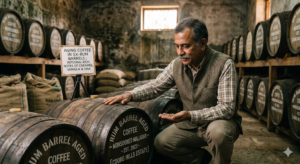
- Barrel Aged: Small-batch experimental method — see our Rum Barrel Aged Coffee guide
The Small Farm Reality
More than 90% of Indian coffee farmers own fewer than 10 acres of land. This is the foundation of India's coffee industry, not its exception. The perception that great Indian specialty coffee must come from large named estates is a misconception that disadvantages the majority of growers. Cooperatives that pool small-farm production for collective processing — like those that transformed Araku — demonstrate that smallholder quality is not only possible but can be internationally competitive.
Sustainability and EUDR
The EU Deforestation Regulation (EUDR) requires that commodities exported to Europe be verified as deforestation-free. For India's shade-grown Western Ghats coffee, the growing method already satisfies the underlying environmental requirement. The current work is building documentation infrastructure — GPS coordinates, forest cover data, chain of custody records — to verify that compliance to regulators and buyers. Indian coffee's inherent sustainability may become a commercial advantage as EUDR implementation progresses.
How to Buy Indian Specialty Coffee
When buying Indian coffee, look for: specific region (not just "Indian Arabica"), processing method, roast date, and altitude. These four fields tell you almost everything about what you're likely to taste. For the complete buying guide, see How to Choose Specialty Coffee and Understanding Coffee Labels.
| You Want... | Choose |
|---|---|
| Chocolate and spice, medium body | Coorg |
| Bright, floral, lighter body | Chikmagalur |
| Low acid, earthy, very full body | Monsoon Malabar |
| Bold body for milk drinks | Wayanad Robusta |
| Fruity, East Africa-like brightness | Araku Valley |
Common Mistakes
Supporting Articles in This Cluster
Taste India's Coffee Diversity
From classic Coorg chocolate to Monsoon Malabar earthiness to experimental barrel-aged lots — India's range in our collection covers the full spectrum of what this origin can do.
Shop Indian Specialty Coffees →