
Specialty Coffee in One Sentence
Specialty coffee is coffee that scores 80 or more out of 100 on the Specialty Coffee Association’s grading scale, distinguished by traceable origins, minimal defects, distinct flavour notes, and careful handling at every stage from farm to cup.
Key Takeaways
- Specialty Coffee scores above 80/100.
- Less than 5% of global coffee qualifies.
- Arabica dominates specialty coffee.
- Processing affects flavour.
- Fresh roasting matters.
- Brewing completes the journey.
What is Specialty Coffee?
Specialty coffee is a term used to describe beans that receive a score of 80 points or more out of 100 by certified graders — meaning very high quality, minimal defects, and distinct, pleasing flavour. It distinguishes itself from mass-produced, commodity coffees in the attention paid to every stage of the process: farming, processing, roasting, and brewing.
The SCA Definition
The Specialty Coffee Association (SCA) formalized the grading framework that the entire industry now uses, setting strict thresholds for defects, moisture content, and screen size alongside the all-important cupping score.Q Graders
Coffee is scored by Q Graders — cuppers certified through the Coffee Quality Institute who are trained to evaluate beans against a standardized sensory rubric, ensuring a score from one lab is comparable to a score from another anywhere in the world.The 100-Point System
Every lot is evaluated across multiple sensory categories on a 100-point cupping form, with the final score determining not just whether a coffee qualifies as specialty, but roughly how exceptional it is within that category.Why 80 Points Matters
Eighty is the hard cutoff: anything below it is, by definition, not specialty coffee, regardless of how it’s marketed. Coffee scoring in the 80s is considered good specialty, the 85+ range is excellent, and anything above 90 is considered exceptional and increasingly rare. Some key features of specialty coffee include traceability and transparency — you often know the exact farm, region, altitude, and processing style — along with distinct flavour notes like fruity, floral, chocolatey, nutty, or winey nuances that depend entirely on origin and microclimate, smaller batches with careful roasting tailored to bring out natural sweetness, and a deep structural emphasis on sustainability and fair practices with growers.New to Specialty Grading?
Before beans ever reach a roaster, their botanical species dictates their baseline complexity. Explore our breakdown on Arabica vs Robusta Coffee to understand why the specialty coffee world is so deeply focused on high-elevation cultivation. Read the Species Guide →How Specialty Coffee is Graded
Grading happens through a process called cupping, where Q Graders brew multiple samples of the same coffee under tightly controlled conditions and score it across eight core categories.Defects
Even a single primary defect — a black bean, an insect-damaged bean, mold — can disqualify a lot from specialty grading entirely, which is why meticulous hand-sorting happens long before beans ever reach a roaster.Fragrance & Aroma
Graders evaluate the dry grounds’ fragrance and then the aroma released once hot water hits the grounds, both of which hint at the volatile compounds that will carry through into flavour.Acidity
Not sourness — acidity in cupping refers to a bright, lively quality that gives a coffee structure and liveliness, prized when it’s clean and well-defined rather than harsh.Sweetness
Natural sugars developed during ripening and processing show up here, with higher-scoring coffees displaying a clear, pleasant sweetness rather than flatness.Balance
This measures how well acidity, sweetness, and body work together, rather than any one quality overwhelming the others.Aftertaste
The flavour and quality that lingers after swallowing — a long, pleasant aftertaste scores significantly higher than a short or unpleasant one.Body
The weight and texture of the coffee on the palate, ranging from light and tea-like to thick and syrupy depending on variety and processing.Uniformity & Overall
Uniformity checks that every cup of the same sample tastes consistent, while the overall score captures the cupper’s holistic impression of the coffee’s quality and character.Commodity Coffee vs Specialty Coffee
| Commodity | Specialty |
|---|---|
| Mixed origins | Single origin |
| Mass roasted | Fresh roasted |
| Unknown farm | Traceable |
| Dark roast | Origin focused |
| Defects allowed | Minimal defects |
| Low price | Premium |
 Commodity coffee is traded largely as an undifferentiated bulk product, blended from many farms and roasted dark to mask inconsistency. Specialty coffee flips every part of that model — origin, freshness, and traceability become the point rather than something to hide.
Why Specialty Coffee Matters
Making the switch away from commercial, factory-roasted coffee shifts your morning completely.Better for Farmers
Purchasing high-grade coffee directly encourages premium payments to small-scale producers, funding ecological farming practices, fair wages, and long-term land care that commodity pricing simply doesn’t support.Better for the Environment
Specialty-focused farms are far more likely to use shade-grown cultivation, minimal chemical inputs, and biodiversity-friendly practices, since quality and ecological care tend to go hand in hand at this level of attention.Better for Consumers
Flavour depth and complexity define the experience — commercial coffees usually hide defects behind a generic, dark “roast” taste, while specialty beans reveal their clear terroir, letting you taste the unique soil, processing variations, and elevation markers in your final cup. It also turns coffee from a mindless caffeine delivery mechanism into an alive, sensory ritual, and because aromatic compounds break down rapidly post-roast, small-batch specialty roasting ensures you receive coffee that retains its vibrant, complex flavour integrity.The Journey From Farm to Cup
Turning a delicate fruit growing on a mountainside into a clean, balanced beverage requires an unyielding chain of custody.
Growing
High altitudes, nutrient-dense volcanic or forest soils, and protective microclimates form the foundation that everything downstream depends on.Picking
On premium estates, only perfectly ripe red cherries are selectively handpicked over multiple passes, completely avoiding the debris and sour, under-ripe beans caused by commercial strip-harvesting.Sorting
Pickers and farm staff remove visibly damaged, diseased, or underripe cherries by hand before the harvest even reaches processing, the first of several quality checkpoints.Floating
Cherries are submerged in water tanks, where dense, healthy cherries sink and underdeveloped or insect-damaged ones float to the surface and are skimmed off.Processing
The method used to remove the seeds from the fruit — washed, natural, honey, or more experimental routes — heavily alters the cup’s final characteristics, covered in full detail below.Drying
Parchment-covered or whole cherries are spread on raised beds or patios and dried slowly to a stable moisture content, with uneven drying being one of the most common sources of defects at this stage.Milling
Once dried, the parchment layer is carefully hulled away, and the green beans undergo meticulous screening, density sorting, and hand-picking to eliminate physical defects.Export
Graded, bagged green coffee is shipped to roasters around the world, with traceability documentation following the lot the entire way so its origin story stays intact.Roasting
Roasting unlocks a bean’s inherent chemical potential through a carefully managed heat curve, covered in depth in the roasting section below.Resting
Freshly roasted beans release carbon dioxide for several days after roasting — a short resting period lets that gas escape so the coffee brews more evenly.Grinding
Whole beans are ground to a particle size matched to the brewing method, directly controlling how quickly water extracts flavour from the coffee.Brewing
The final moment of truth — even a world-class harvest can be completely muted by an inconsistent particle size, incorrect water temperature, or an uncalibrated extraction time.Coffee Processing
The method used to remove the seeds from the fruit heavily alters your cup’s final characteristics.
| Processing Method | How It Works | Expected Flavour Profile |
|---|---|---|
| Washed / Wet | Fruit skin is mechanically pulped, beans are fermented, then washed completely clean. | Crisp clarity, bright acidity, and very clean finishes. |
| Natural / Dry | Cherries are dried entirely whole on raised beds before being milled. | Heavy body, intense fruit sweetness, and complex, wild notes. |
| Honey / Pulped Natural | The outer skin is removed, but sticky fruit mucilage is left on the bean while drying. | Balanced profile blending deep honey sweetness with washed clarity. |
| Anaerobic | Cherries ferment in sealed, oxygen-free tanks before processing continues. | Bold, often tropical or boozy notes not found in open-air fermentation. |
| Carbonic Maceration | Whole cherries ferment in a CO2-rich sealed environment, borrowed from winemaking. | Vivid, intensely fruity and floral profiles. |
| Experimental | Includes yeast, lactic, and barrel-aged fermentation techniques layered on top of standard methods. | Highly varied — from creamy and tangy to spiced and boozy. |
| Monsooned | Beans are exposed to monsoon winds and humidity over several weeks, a method unique to India. | Low acidity, heavy body, earthy and mellow character. |
| Semi Washed | Brief fermentation and rinse, followed by hulling while the bean is still high in moisture. | Earthy, low-acid, full-bodied — the hallmark of Sumatran coffee. |
Coffee Roasting & Roast Levels
Roasting aims to unlock a bean’s inherent chemical potential. It is an intricate, mathematical balance — roast too light and the coffee tastes grassy and underdeveloped; roast too dark and you char away the unique origin notes. Artisanal roasters monitor development curves millisecond by millisecond.
Light Roast
Stopped early, before much sugar caramelization occurs, preserving the brightest acidity and clearest origin character — best suited to washed and lighter honey-processed coffees.Medium Roast
A balanced profile that rounds off some acidity while still preserving origin character, often the most versatile roast level across different beans and brew methods.Dark Roast
Pushed further into caramelization and the start of carbonization, producing bold, bittersweet, smoky notes that increasingly mask origin character the darker it goes.Espresso Roast
Typically a medium-dark profile developed specifically to balance with milk and hold up under pressure extraction, though many specialty roasters now pull espresso from lighter roasts to preserve more clarity. Different processing methods affect bean density and sugar content, which in turn changes how a coffee responds to heat — natural and honey-processed beans, being denser with sugar, often roast differently than washed beans of the same variety. For the full breakdown of curves, timing, and how to read a roast for yourself, see our dedicated Roast Guide.Freshness
Roast Date
Always check the roast date, not the “best by” date — coffee is at its best roughly 5 to 21 days after roasting, once initial degassing has settled but before aromatics begin fading.Degassing
Freshly roasted beans release carbon dioxide for days after roasting, which is why coffee bought too soon after roasting can bloom aggressively and brew inconsistently until that gas has settled.Storage
Store beans in an airtight, opaque container away from heat, light, and moisture — all four accelerate the breakdown of the volatile aromatic compounds that define a specialty coffee’s character.Freezing Coffee
Freezing whole beans in a well-sealed, airtight container can meaningfully extend freshness for longer-term storage, though beans should be portioned in advance to avoid repeated freeze-thaw cycles that introduce moisture.Shelf Life
Whole beans stay reasonably fresh for several weeks past their roast date, but ground coffee loses its aromatic complexity within days, which is part of why grinding immediately before brewing matters so much.
Grind Size
Grind is everything: if your grind size doesn’t match your brewing equipment, water will flow unevenly, causing sour under-extraction or bitter over-extraction.
Espresso
A fine, almost powder-like grind that creates enough resistance for pressurized water to extract quickly and evenly within roughly 25 to 30 seconds.Moka Pot
Slightly coarser than espresso but still fine, fine enough to build pressure in the lower chamber without clogging the filter basket.AeroPress
A flexible medium-fine grind that can be adjusted finer or coarser depending on brew time and desired strength.V60
A medium grind, similar in texture to table salt, that balances flow rate against contact time for a clean, well-extracted pour-over.French Press
A coarse, even grind that prevents fine particles from passing through the metal mesh filter and producing sediment in the cup.Cold Brew
The coarsest grind of all, since the long steep time of cold brewing would over-extract and turn bitter at any finer setting. Use a burr grinder, not a blade grinder — blade grinders smash coffee into chaotic, uneven chunks and dust, while a quality burr grinder provides uniform particle distribution for a smooth, sweet, and balanced extraction. Bookmark our permanent Coffee Grind Size Guide to always keep your kitchen setup perfectly calibrated.Water
People underestimate this — water makes up over 98% of a brewed cup, so its quality directly shapes the final flavour.Mineral Content
A small amount of dissolved minerals, particularly magnesium and calcium, actually helps extraction and flavour development — completely pure distilled water often brews flat and lifeless.Hardness
Very hard water can over-extract and taste chalky or harsh, while very soft water can under-extract and taste thin — a moderate middle ground works best for most specialty coffee.Filtered Water
Always use filtered water if your tap water tastes heavily chlorinated, since chlorine and other strong tap flavours will carry directly into your cup.TDS
Total Dissolved Solids (TDS) measures the mineral concentration in water, with most specialty brewing guides recommending a TDS range of roughly 75–250 ppm for balanced extraction.Temperature
Target a temperature window between 90–96°C (195–205°F). Avoid boiling water off the stove as it can scald delicate flavour notes.Brewing Ratio
| Method | Ratio |
|---|---|
| V60 | 1:16 |
| French Press | 1:15 |
| AeroPress | 1:15 |
| Cold Brew | 1:8 |
| Espresso | 1:2 |
 A highly dependable starting configuration is a 1:16 weight ratio for pour-over — 1 gram of coffee for every 16 grams of water. You can adjust this slightly tighter or looser to fit your specific palate, but weighing both coffee and water, rather than eyeballing scoops and cups, is the single biggest upgrade most home brewers can make.
Common Beginner Mistakes
How to Choose Your First Specialty Coffee
Why Indian Specialty Coffee is Growing
India has quietly become one of the most interesting specialty coffee origins in the world, shaped by shade-grown traditions, biodiverse forest farming, and a new generation of producers focused on quality over volume.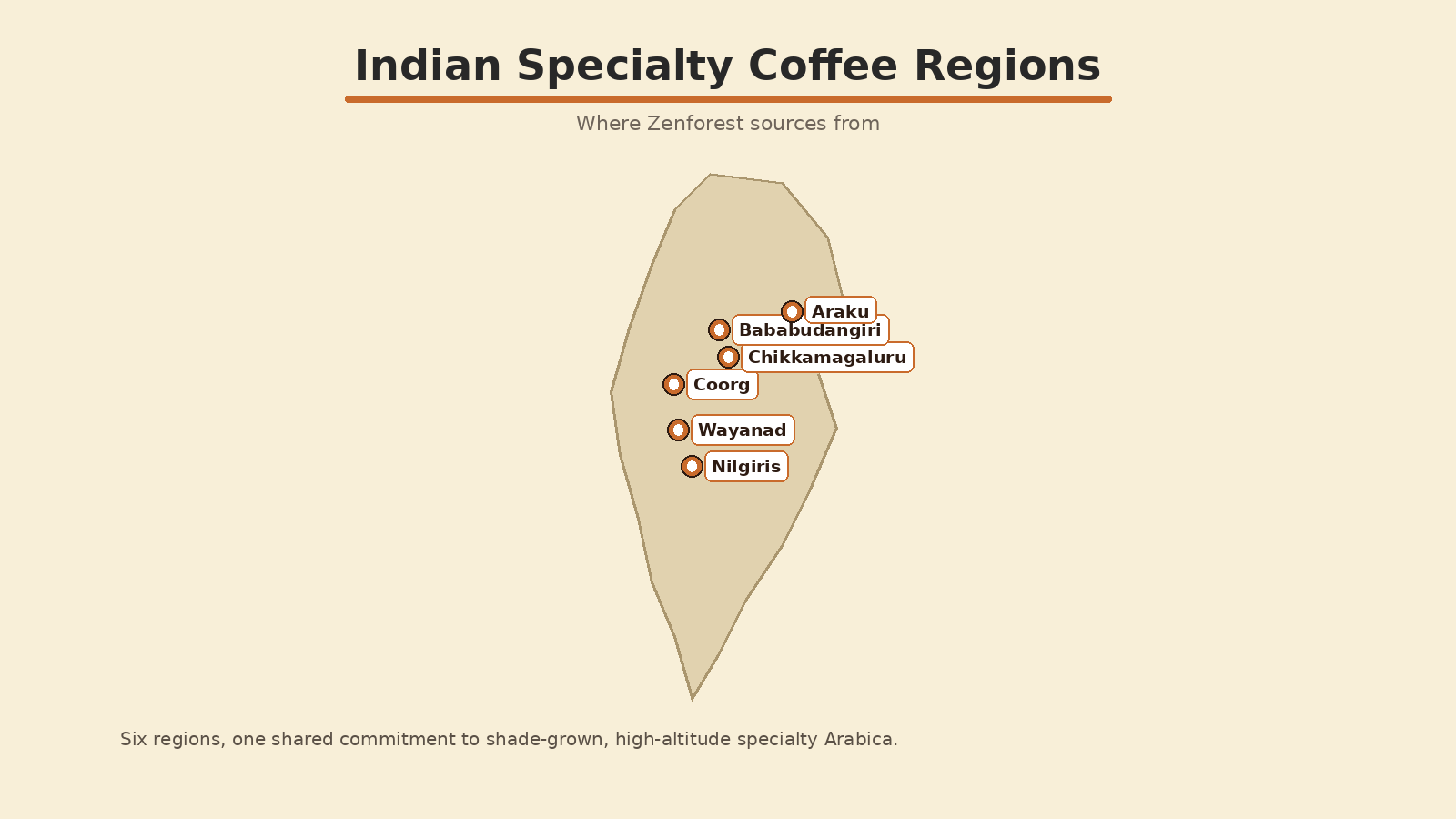
Coorg
Both washed and natural processing are common in Coorg, with a growing number of estates experimenting with honey and natural lots specifically for the specialty market.Chikkamagaluru
Washed processing dominates here, prized for preserving the brighter, floral character that the region’s higher altitude produces.Araku
Cooperative-run facilities across Araku increasingly produce natural and honey lots to highlight the region’s naturally fruity, tangy profile.Bababudangiri
Small, high-altitude lots here are processed especially carefully — typically washed — to protect the delicate character this micro-origin is known for.Nilgiris
A cooler, high-elevation region producing increasingly well-regarded Arabica lots, with specialty-focused processing still in its earlier growth stages compared to Coorg or Chikkamagaluru.Wayanad
Predominantly washed and natural processing for Robusta, with the natural method especially common given the region’s warm, humid climate suited to sun-drying whole cherries. Indian specialty producers more broadly are increasingly adopting experimental methods — anaerobic fermentation, honey processing, and barrel aging in particular — as the country’s specialty coffee movement matures and producers look to differentiate their lots in an increasingly competitive global market. For the full regional breakdown, see our Indian Coffee Regions Guide.Common Myths
Frequently Asked Questions
What is specialty coffee?
Specialty coffee is coffee that scores 80 or more out of 100 on the SCA cupping scale, distinguished by traceable origins, minimal defects, and distinct, high-quality flavour.
Why is specialty coffee expensive?
It reflects the real cost of selective hand-harvesting, careful processing, lower yields per farm, and fairer payments to producers, none of which apply to mass-produced commodity coffee.
Does specialty coffee have more caffeine?
Not inherently. Caffeine content depends mainly on species and roast level, not on whether a coffee qualifies as specialty grade.
Can beginners drink specialty coffee?
Yes. Specialty coffee is for anyone who enjoys a better, more flavourful cup — no prior experience is needed to appreciate it.
Is specialty coffee organic?
Not automatically. Specialty grading is about quality and flavour, not certification — though many specialty farms do follow organic or near-organic practices by nature of their careful cultivation.
How long does specialty coffee stay fresh?
Whole beans are generally best within 5 to 21 days after roasting, and stay reasonably good for a few weeks beyond that if stored properly in an airtight container.
Why does roast date matter more than expiry date?
Coffee’s flavour compounds begin degrading immediately after roasting, so the roast date tells you far more about freshness than a generic best-by date ever could.
Is Arabica always specialty?
No. Arabica dominates specialty coffee because of its complexity potential, but not all Arabica qualifies — quality still depends on growing conditions, processing, and grading.
How is specialty coffee graded?
Certified Q Graders cup samples and score them across categories including fragrance, acidity, sweetness, balance, body, and aftertaste, with a total score of 80 or above qualifying as specialty.
Can Robusta be specialty?
Yes, though it’s rarer. Fine Robusta grading exists under a separate but related framework, and a small but growing number of high-quality Robusta lots do qualify.
How should I store specialty coffee?
In an airtight, opaque container, away from heat, light, and moisture, ideally kept whole bean until just before brewing.
Whole bean vs ground — which is better?
Whole bean, almost always. Ground coffee loses its aromatic complexity within days, while whole beans hold their freshness considerably longer.
Does altitude matter for specialty coffee?
Yes. Higher altitudes generally slow cherry development, allowing more complex sugars and acids to form, which is part of why so many specialty origins are grown at elevation.
What grinder should I buy?
A burr grinder, not a blade grinder — burr grinders produce a consistent particle size, which is essential for even, balanced extraction.
Can I use tap water for brewing?
You can, but filtered water is strongly recommended if your tap water tastes heavily chlorinated or mineral-heavy, since that flavour carries directly into your cup.
Does specialty coffee taste sour?
It shouldn’t. A well-extracted specialty coffee tastes bright and lively, not sour — sourness usually indicates under-extraction, a grind that’s too coarse, or water that’s too cool.
What brewing method is easiest for beginners?
A French press or AeroPress is generally the most forgiving starting point, since both have a wider margin for error than precision pour-over methods.
Why does coffee taste fruity?
Fruity notes typically come from natural or honey processing, where the bean stays in extended contact with the cherry’s sugars during drying.
Can I make espresso at home without a machine?
Not true espresso, which requires pressurized extraction, but a moka pot can produce a strong, espresso-like concentrate using just stovetop heat.
Where should I start with specialty coffee?
Start with a washed, medium-roast single origin to build a baseline for what clean, balanced coffee tastes like, then branch into honey, natural, and experimental lots from there.
Continue Learning
Learn More
Explore Specialty Coffee with Zenforest
We believe in full transparency across our sourcing lines. As you explore our ecosystem, look out for these core hubs: our Estates page, where you can read up on the dedicated farm profiles of the small-scale producers across Chikkamagaluru and Coorg who raise our harvests under thick forest canopies, and our Roasting Philosophy in the About Us section, where you can see how we roast light, medium, and experimental micro-lots to champion natural sweetness.Follow our processing logs and stay updated with live seasonal estate harvests on Instagram.