


Monsoon Malabar Coffee is one of India’s most distinctive and celebrated specialty coffees — and one of the most unusual in the world. Unlike every other coffee you’ve encountered, its flavour isn’t shaped primarily by soil, altitude, or the roaster’s skill. It’s shaped by weather. Specifically, by the seasonal monsoon winds that roll in off the Arabian Sea and saturate India’s Malabar Coast for weeks at a time, turning freshly processed green beans into something entirely different in colour, size, texture, and taste.
The result is a coffee with exceptionally low acidity, a heavy syrupy body, and deep notes of cocoa, roasted nuts, malt, and earth — a profile that has no real equivalent anywhere else in the world. For those who find most specialty coffee too bright or too acidic, or who simply want to experience what Indian coffee history actually tastes like in a cup, Monsoon Malabar is the clearest answer in existence.
Quick Answer
Monsoon Malabar Coffee is a uniquely Indian specialty coffee made by exposing green coffee beans to the humid monsoon winds of India’s western coast for several weeks. This process causes the beans to swell, lose acidity, and develop a distinctive flavour profile — low acid, heavy body, cocoa richness, roasted nuttiness, and mild earthiness — that cannot be replicated anywhere else in the world.
Key Takeaways
- Monsoon Malabar’s flavour is shaped by seasonal weather, not additives.
- The process was originally an accident of colonial-era sea transport.
- It’s one of the world’s most geographically unique coffees.
- Exceptionally low acidity makes it accessible for sensitive stomachs.
- It excels in espresso, French press, and moka pot.
- It’s deeply connected to India’s coffee heritage and Malabar Coast identity.
The Origin of Monsoon Malabar Coffee
The story of Monsoon Malabar begins not in a lab or a processing facility, but on a ship. During the colonial era, coffee harvested from India’s western highlands was loaded onto wooden sailing vessels and transported to Europe via the Cape of Good Hope — a journey that took several months crossing the open ocean. During that crossing, the sacks of green coffee were exposed to salt air, humidity, and the rolling moisture of monsoon winds blowing off the Arabian Sea.
By the time the coffee arrived in European ports, it had transformed. The beans had swollen in size, turned a pale golden colour, and developed a mellow, earthy, low-acid character that European buyers — who had never tasted freshly transported coffee — came to know as the defining flavour of Indian coffee. It was what they expected. It was what they wanted.
The Problem Modern Shipping Created
When steamships replaced sailing vessels, the journey from India to Europe shortened dramatically. Coffee began arriving quickly, still green and sharp, without the months of maritime exposure that had defined its character. European buyers complained. The coffee they received bore no resemblance to the mellow, full-bodied Indian coffee they’d come to love. The sea journey itself had been producing a flavour they now couldn’t replicate with faster shipping.
Recreating the Process on Land
Indian producers responded by developing the monsooning process — a deliberate, land-based method for recreating the conditions those ships had provided accidentally. Coffee beans are now warehoused in open-sided facilities along the Malabar Coast and exposed to monsoon winds in a controlled way, turning an accident of history into one of the world’s most distinctive coffee processing traditions.
How Monsoon Malabar Coffee is Processed
The monsooning process is unlike any other in the coffee processing world. It begins after the coffee has already been harvested, depulped, fermented, washed, and dried in the conventional manner — the monsooning is a second phase applied to the already-processed green bean.
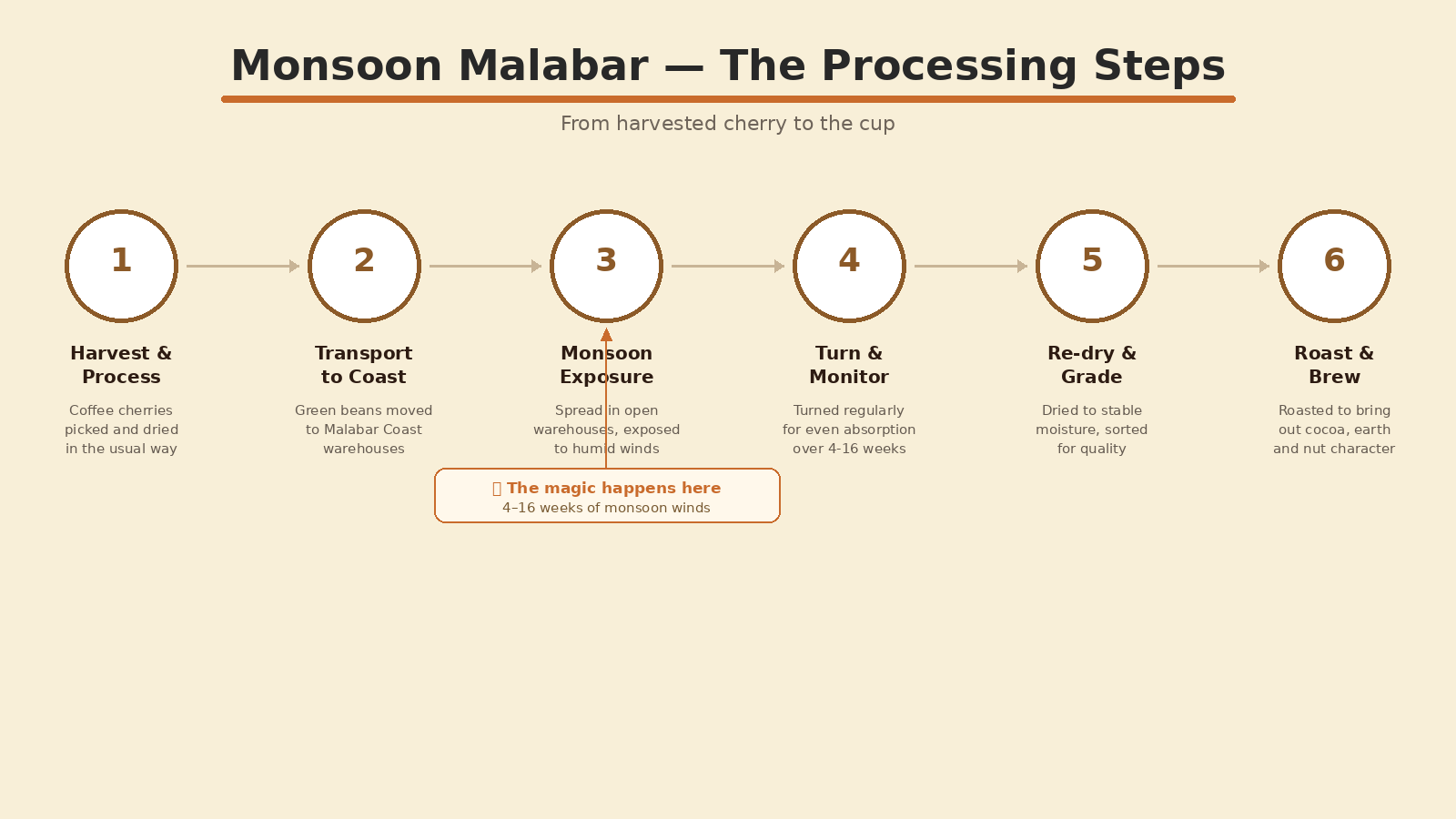
Step 1: Warehousing on the Malabar Coast
Processed green beans are transported to open-sided warehouses along India’s Malabar Coast — specifically in Karnataka and Kerala — positioned to receive direct exposure to the southwest monsoon winds that blow in from June to September each year. The location is not incidental; the coastal humidity and specific character of the monsoon air cannot be replicated inland.
Step 2: Spreading and Turning
The beans are spread in thick layers on the warehouse floor and turned regularly — daily or every few days — to ensure even exposure across all the beans. If left unturned, uneven absorption leads to inconsistent quality, with some beans over-moistened and others barely affected.
Step 3: Weeks of Monsoon Exposure
The process runs for anywhere from four to sixteen weeks depending on the producer’s target profile. During this time, the beans absorb moisture from the humid monsoon air, causing a series of physical and chemical transformations that collectively produce the Monsoon Malabar character.
Step 4: Re-drying and Grading
Once the desired level of exposure is achieved, the beans are re-dried to a stable moisture content, sorted and graded for export, and then shipped to roasters. The grading step is particularly important — the process inevitably produces some beans that absorbed too much or too little, and these are removed to ensure quality consistency in the final export lot.
What Changes During Monsooning
| Characteristic | Before Monsooning | After Monsooning |
|---|---|---|
| Bean colour | Green | Pale golden yellow |
| Bean size | Standard | Significantly larger |
| Acidity | Medium-high | Very low |
| Body | Light to medium | Heavy |
| Flavour character | Origin-forward | Earthy, nutty, cocoa |
| Moisture content | Stable | Elevated, then re-dried |
What Does Monsoon Malabar Coffee Taste Like?
Monsoon Malabar has one of the most immediately recognisable flavour profiles in the specialty coffee world — heavy, smooth, earthy, and deeply satisfying in a way that feels more like a warm, savoury dessert than a bright, fruit-forward specialty lot.
Aroma
The aroma is one of the first things you notice — deeply woody and earthy on the dry grounds, shifting to warm cocoa, malt, and roasted nuts once hot water hits them. There’s an almost tobacco-like quality to the wet aroma that distinguishes it clearly from fruit-forward or floral coffees.
Sweetness
The sweetness is muted and savory rather than pronounced — closer to malt or dark molasses than fruit or caramel. It provides balance and depth rather than acting as the cup’s defining quality.
Body
The body is the defining feature — thick, coating, and persistent. Monsoon Malabar fills the palate in a way that lighter-processed coffees simply don’t, which is part of why it performs so well in espresso and French press.
Acidity
The acidity is almost entirely absent — one of the lowest in the specialty coffee world. This is one of its most important characteristics and a primary reason drinkers with acid sensitivity gravitate toward it.
Aftertaste
The finish is long, warm, and slightly spiced — earthy notes linger considerably after swallowing, with hints of dried fruit and dark chocolate that make it particularly satisfying drunk slowly over time.
Common Tasting Notes
Chocolate
Cocoa, dark chocolate, and mocha — the dominant flavour thread running through almost every cup.
Nutty
Roasted nuts, malt, and a subtle hazelnut character that sits comfortably beneath the chocolate notes.
Earthy
A clean, woody earthiness that gives the cup grounding and distinction — the unmistakable monsoon signature.
Why Is Monsoon Malabar So Low in Acidity?
The monsooning process fundamentally alters the bean’s chemistry in ways that directly reduce acidity. The prolonged exposure to moist, humid air triggers a slow oxidation of the organic acids naturally present in green coffee — citric, malic, and phosphoric acids, which create the brightness in most specialty coffees, are substantially reduced during the weeks of monsoon exposure.
Think of it as the coffee equivalent of aging — similar to how wine softens and loses harsh tannins over time in a barrel, or how bread dough mellows during a long, slow ferment. The time and environmental exposure transform sharp, lively acidity into smooth, round depth.
This is what makes Monsoon Malabar genuinely useful for coffee drinkers who struggle with coffee acidity — not because it’s been processed to remove acidity as a side effect, but because the entire process is designed to produce that smoothness as its primary outcome.
Monsoon Malabar vs Regular Coffee
| Feature | Monsoon Malabar | Regular Specialty Coffee |
|---|---|---|
| Acidity | Very low | Medium to high |
| Body | Very heavy | Light to medium |
| Flavour | Earthy, nutty, cocoa | Varies — fruit, floral, caramel |
| Processing | Monsooned (unique) | Washed, natural, honey |
| Mouthfeel | Rich, coating, smooth | Varies |
| Origin Identity | Unique to India | Global |
| Best Suited For | Low-acid seekers, bold profiles | Full specialty range |
Monsoon Malabar vs Other Indian Coffees
India produces a diverse range of specialty coffees across its growing regions, and Monsoon Malabar sits at one distinct end of the spectrum. Understanding how it compares to other Indian coffee origins gives a clearer picture of where it fits in the broader landscape.
vs Chikkamagaluru Arabica
Chikkamagaluru produces some of India’s cleanest, most classic washed Arabica — bright, floral, and medium-bodied, with defined acidity. Monsoon Malabar is almost the opposite — earthy, heavy, and stripped of brightness. Both are excellent; they suit completely different palates.
vs Coorg Highlands
Coorg coffees tend toward fruit-forward, balanced profiles depending on processing. Where Coorg Highlands can be bright and dynamic, Monsoon Malabar is mellow and grounded — a counterpart rather than a competitor.
vs Arabica vs Robusta
Traditional Monsoon Malabar is produced from Arabica, though some variations include Robusta depending on the producer. Understanding the difference between Arabica and Robusta helps explain why Monsoon Malabar AA — where “AA” indicates a large screen size grading — is so prized: it starts with carefully graded Arabica before monsooning even begins.
Explore India’s Coffee Growing Regions
Curious how Monsoon Malabar compares with coffees from Coorg, Chikkamagaluru, and Araku? Our Indian coffee regions guide covers every major growing area in depth.
How Roasting Shapes the Final Cup
Monsoon Malabar responds differently to roasting than most green coffees. The monsooning process changes the bean’s density and moisture structure, which means it requires careful adjustment to the roast profile to develop fully without scorching the already-altered exterior.
Medium to Medium-Dark Roast
Most Monsoon Malabar is roasted at medium to medium-dark levels, which develops the cocoa and nutty notes fully while preserving the earthy character that defines the coffee. Very light roasts can make it taste grassy or underdeveloped; very dark roasts risk masking its distinctive earthy signature under pure carbon bitterness.
Development Time
Longer development time during the roast helps integrate the bean’s unusual moisture history into a cohesive, balanced flavour. Roasters familiar with Monsoon Malabar typically run it slower and longer through the development phase compared to standard lots of similar bean density.
Best Brewing Methods for Monsoon Malabar
Monsoon Malabar’s heavy body, low acidity, and bold earthy character make it particularly suited to brewing methods that emphasise extraction depth and allow oils to come through freely.
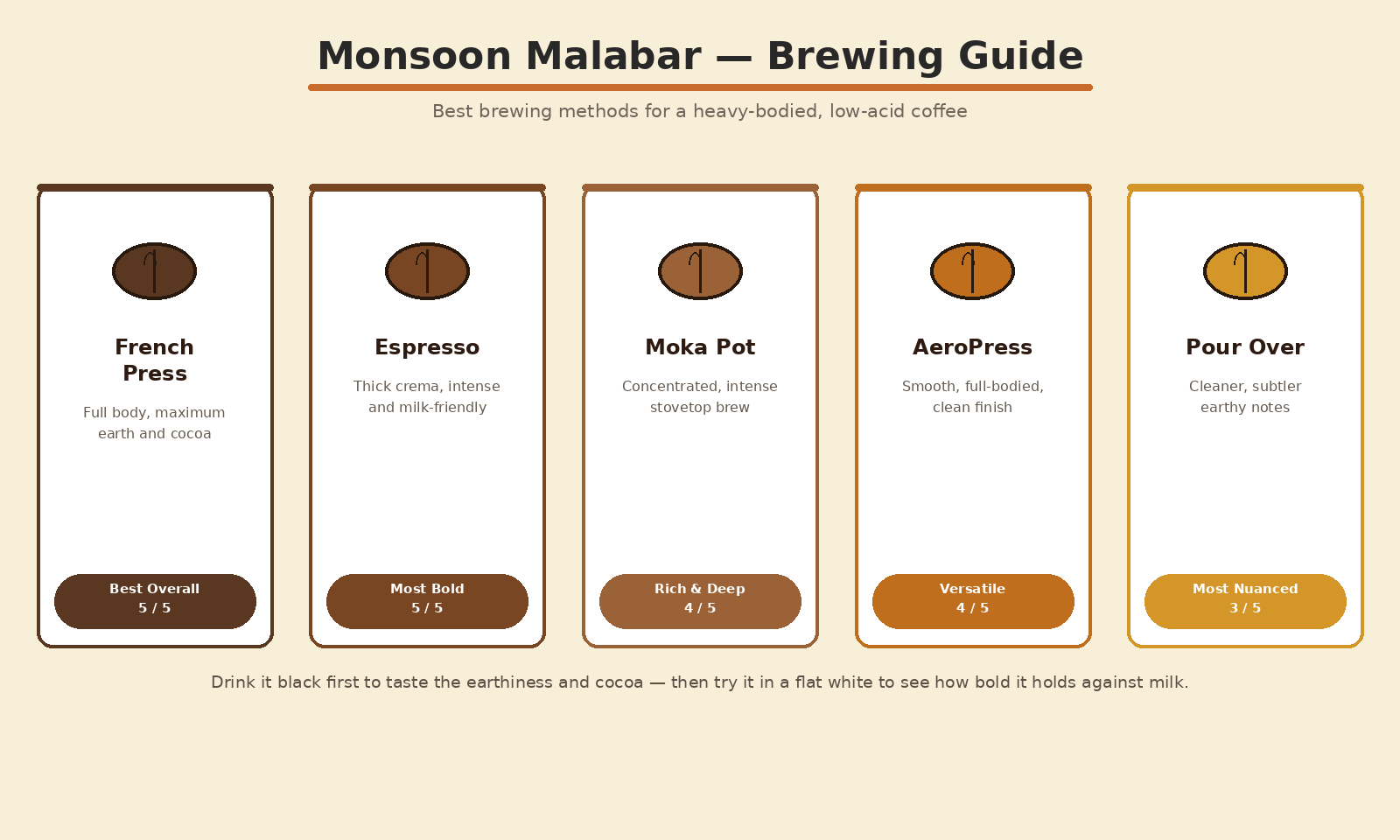
| Brew Method | What it Highlights | Rating |
|---|---|---|
| French Press | Maximum body, full earthy character | ⭐⭐⭐⭐⭐ |
| Espresso | Concentrated depth, thick crema | ⭐⭐⭐⭐⭐ |
| Moka Pot | Intense, stovetop-concentrated | ⭐⭐⭐⭐ |
| AeroPress | Controlled, smooth, full | ⭐⭐⭐⭐ |
| Pour Over | Cleaner, less earthiness | ⭐⭐⭐ |
French Press
The French press is the natural home for Monsoon Malabar — immersion brewing with a metal mesh filter allows all of the coffee’s oils and fine particles to pass through freely, building maximum body and letting the earthy, cocoa character develop fully. Use a coarse grind and steep for four minutes.
Espresso
Monsoon Malabar makes an exceptional espresso — the heavy body translates into a thick, rich shot with remarkable crema and a deeply satisfying finish. It performs particularly well as the base in milk drinks, where its boldness holds its own against steamed milk. See our Espresso Brewing Guide for extraction tips.
Moka Pot
The moka pot concentrates the earthy cocoa character into an intensely satisfying stovetop brew. Use a medium-fine grind and remove from heat as soon as sputtering begins — over-extraction amplifies bitterness significantly in a coffee already this bold.
AeroPress
The AeroPress gives good control over steep time and pressure, producing a smooth, full-bodied cup with the earthiness intact. A two-minute steep with a medium-fine grind and gentle press produces a clean, satisfying result.
Pour Over
A pour over is less common for Monsoon Malabar but works for those who want a cleaner, less intense expression — the paper filter removes some of the oils and sediment that contribute to earthiness, producing a mellower version of the profile.
With Milk or Black?
Monsoon Malabar works well both ways, and the two experiences are meaningfully different.
Drunk Black
Black is the fullest expression of the coffee’s character — the earthiness, cocoa depth, and distinctive monsooned quality come through most clearly without milk softening them. Particularly recommended for experienced drinkers who want to understand what makes this coffee unique.
With Milk
The bold, low-acid profile means Monsoon Malabar holds its character well in milk drinks. The cocoa notes interact with milk’s natural sweetness in a way that resembles a mocha without any added flavouring — an exceptionally good choice as the base for a flat white or cappuccino.
Who Should Drink Monsoon Malabar?
Monsoon Malabar suits a specific kind of coffee drinker — and excludes another. Being clear about this saves disappointment on both sides.
Acid-Sensitive Drinkers
Its extremely low acidity makes it one of the most stomach-friendly specialty coffees available — a genuine alternative to dark-roasted low-acid blends.
Espresso Lovers
The thick body and rich crema make it one of the best single-origin choices for espresso drinkers who want boldness without brightness.
Indian Coffee Explorers
No coffee is more distinctly, historically Indian than Monsoon Malabar — it’s the logical starting point for anyone interested in the story of Indian coffee.
It may be less suitable for drinkers who prefer bright, fruity, or floral coffees — light-roasted washed lots from Ethiopia or Coorg will serve that palate far better.
Why Monsoon Malabar Is Special in the Specialty Coffee World
Few coffees have a story as distinctive as Monsoon Malabar. Its flavour notes are shaped not only by the terroir of where it grows, but by the seasonal climate of where it dries — a distinction that no other major coffee has. The combination of colonial history, geographic specificity, and a processing method that cannot be meaningfully replicated anywhere outside India’s Malabar Coast gives it a genuinely unique identity in a world where truly unique coffees are rare.
It also sits at an interesting point in the specialty coffee conversation — it challenges some of the movement’s conventional preferences (brightness, fruit-forwardness, light roasting) while representing a genuine tradition with deep cultural and historical roots. For many coffee professionals, Monsoon Malabar is evidence that “specialty” means more than one thing, and that complexity and quality can take many forms.
Zenforest Expert TipTry Monsoon Malabar in a French press with no milk first — this is where its full character is most visible. Then pull it as espresso and compare the two. The same coffee will taste noticeably different across these two methods, and comparing them side by side is one of the fastest ways to understand how brewing ratios and method shape the cup independently of the bean itself.
Common Mistakes
Frequently Asked Questions
Is Monsoon Malabar Coffee strong?
It’s full-bodied and flavourful, but caffeine content is comparable to other Arabica coffees of similar roast level. The perception of strength comes from body and flavour depth, not caffeine.
Does Monsoon Malabar contain Robusta?
Traditional Monsoon Malabar AA is produced from Arabica beans. Some producers do process Robusta through monsooning, but these are usually labelled separately. For the full Arabica vs Robusta distinction, see our dedicated guide.
Why are the beans pale golden and larger than usual?
The beans absorb moisture during monsooning, causing them to swell significantly in size. The chemical changes during this process also remove chlorophyll and other pigments, shifting the colour from green to pale golden yellow.
Is Monsoon Malabar good for espresso?
Excellent. Its low acidity, heavy body, and rich cocoa profile make it one of the best single-origin choices for espresso, particularly in milk-based drinks where its boldness comes through clearly.
Is it suitable for people who find coffee too acidic?
Yes — Monsoon Malabar is one of the recommended options for acid-sensitive coffee drinkers, as its monsooning process substantially reduces the organic acids that cause brightness and stomach discomfort in other coffees.
Can I use it in a French press?
The French press is arguably the best method for Monsoon Malabar — the full-immersion style and metal filter allow all of the body and oil character to pass through, which is exactly what this coffee is built for.
How should I store Monsoon Malabar?
In an airtight, opaque container at room temperature, away from heat and light. The earthy aromatic compounds can fade quickly if stored poorly — full guidance in our Coffee Storage Guide.
Continue Learning
Coffee Processing Methods
→
Indian Coffee Regions
→
Coffee Acidity Explained
→
Coffee Body Explained
→
Arabica vs Robusta
→
Roast Levels Guide
→
Recommended Coffees
Ready to Try It?
Also From India’s Coffee Belt
Other Bold Coffees You Might Love
Learn More
A Coffee That Could Only Come From India
Monsoon Malabar isn’t just a processing method — it’s a piece of living history. The same coastal winds that accidentally transformed colonial-era coffee shipments still blow through open warehouses on the Malabar Coast today, still doing the same work, still producing the same unmistakable result. No other country has this combination of coastal geography, monsoon climate, and historical precedent to build this kind of coffee.
If you haven’t tried it, start with a French press. Drink it black. Let it cool slightly and taste again — the earthy complexity deepens as the temperature drops. Then try it as espresso and see how the same bean transforms under pressure into something richer and more concentrated still. Monsoon Malabar is a coffee worth tasting slowly and carefully, because it has more to say than most.
Experience Monsoon Malabar AA
Crafted from premium Indian Arabica and aged by the Malabar Coast’s monsoon winds, our Monsoon Malabar AA delivers rich cocoa, roasted nuttiness, and a smooth, low-acid character deeply connected to India’s coffee heritage.


