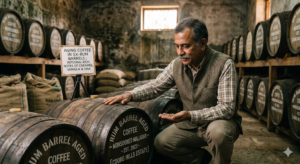

Few coffees stop people in their tracks the way Rum Barrel Aged Coffee does — and it's not just the name. Barrel ageing is one of the most labour-intensive, time-sensitive processing experiments in specialty coffee today, borrowing a centuries-old technique from the spirits world and applying it to green coffee beans with genuinely extraordinary results. The beans spend weeks absorbing aromatic compounds from oak staves still coated in rum residue, emerging transformed — heavier, more complex, and carrying flavour dimensions no roast profile alone could ever create.
At Zenforest, our Rum Barrel Aged Coffee is crafted from premium Indian Arabica, sourced from the same high-altitude growing regions we use across our specialty range, then carefully aged in authentic rum barrels before roasting. The result is a cup that carries the clarity of well-grown Indian coffee alongside deep notes of oak, molasses, dark chocolate, and warm spice — a genuinely different kind of specialty experience.
Quick Answer
Rum Barrel Aged Coffee is specialty coffee that has been aged inside barrels previously used for maturing rum, allowing the green beans to absorb oak and spirit-derived aromatic compounds before roasting. It contains no alcohol — the roasting process eliminates any residual content — and delivers a rich, layered cup with notes of oak, molasses, dark chocolate, caramel, and warm spice.
Key Takeaways
- Rum Barrel Aged Coffee contains no alcohol — roasting eliminates any residue.
- Flavour comes from oak and rum-derived aromatic compounds, not added flavouring.
- The ageing happens before roasting, at the green bean stage.
- It suits French press, espresso, moka pot, and works well with milk.
- It's one of the most complex experimental coffees in the Zenforest range.
What is Rum Barrel Aged Coffee?
Rum Barrel Aged Coffee is specialty coffee — typically green, unroasted beans — that has been placed inside barrels previously used to mature rum and allowed to rest there for an extended period under controlled conditions. During that resting phase, the beans slowly absorb aromatic compounds from the oak wood and the rum residue that saturates the staves, developing flavour characteristics that exist nowhere else in the coffee world.
The process sits firmly within the broader category of experimental coffee processing, a movement that has reshaped what specialty coffee can taste like over the past decade. Like Monsoon Malabar — which exposes beans to seasonal ocean winds — barrel ageing is another form of post-harvest, pre-roast intervention that uses an environmental influence to shape the bean's final flavour profile in ways that growing conditions and roasting alone cannot replicate.
How is it Different From Flavoured Coffee?
This is an important distinction. Rum Barrel Aged Coffee is not flavoured coffee — no extracts, syrups, or artificial compounds are added at any stage. The flavour development happens entirely through absorption of naturally occurring compounds from the barrel itself. This puts it in the same category as wine aged in oak, whisky matured in sherry casks, or any other spirit whose character is shaped by the vessel it rests in — a process driven entirely by chemistry and time, not additives.
Where Does Barrel Ageing Fit in Specialty Coffee?
Barrel ageing belongs to the experimental processing movement that has produced techniques like anaerobic fermentation, carbonic maceration, and cinnamon fermentation. What distinguishes barrel ageing from those methods is that the flavour influence comes almost entirely from outside the coffee's own fruit chemistry — from an external vessel with its own deep aromatic history. That external influence is precisely what gives barrel-aged coffees such a distinctive and immediately recognisable character.
How is Rum Barrel Aged Coffee Made?
The process is straightforward in principle and demanding in practice. Every stage requires careful judgment about timing, conditions, and the condition of both the beans and the barrels being used.
Sourcing the Beans
It starts with high-quality green coffee. Barrel ageing amplifies and transforms existing flavour characteristics — it doesn't create quality from poor raw material. The same considerations that matter for any specialty coffee apply here: origin, altitude, variety, and processing method before ageing all shape the final result. At Zenforest, we use high-altitude Indian Arabica from the same growing regions behind our other single-origin coffees.
Selecting the Barrels
Not all rum barrels produce the same result. The type of rum matured in the barrel — white, dark, spiced — its age, how heavily it was charred, and how much residual spirit remains all contribute differently. Barrels from aged dark rum tend to produce the deepest, most complex coffee character, with heavier molasses, oak, and dried fruit influence.
The Ageing Process
Green beans are loaded into the barrels, sealed, and stored in controlled conditions for a period that typically runs from several weeks to a few months. Temperature, humidity, and airflow all matter during this period — the same variables that matter during coffee storage more generally, but here working actively to shape flavour rather than preserve it. The beans gradually absorb volatile aromatic compounds from the wood and residual rum, while the barrel's porosity allows a slow exchange with the surrounding air.
Roasting After Ageing
Once ageing is complete, the beans are roasted. This is where the transformation is locked in — the roast develops the coffee's inherent character while integrating the barrel-derived compounds into a unified flavour profile. Roasting barrel-aged beans requires adjustment compared to unaged lots, since the moisture content and density have changed during the ageing period. Roast level also has a significant bearing on the final character, as discussed in more detail below.
Does Rum Barrel Aged Coffee Contain Alcohol?
No — and this is one of the most frequently asked questions about barrel-aged coffee. Rum Barrel Aged Coffee is completely non-alcoholic. The ageing process transfers aromatic compounds and flavour molecules from the barrel into the bean, but any residual alcohol content is fully eliminated during roasting, where bean temperatures far exceed the boiling point of alcohol.
What the finished coffee retains is purely sensory — the aromas and flavour notes that the rum and oak imparted, not any intoxicating compounds. It is safe to drink at any time of day, suitable for all ages, and carries no more alcohol than any other roasted coffee.
What Does Rum Barrel Aged Coffee Taste Like?
Rum Barrel Aged Coffee is known for its rich, layered character — a cup that unfolds in stages rather than presenting a single straightforward note.

| Flavour Category | Specific Notes |
|---|---|
| Chocolate | Dark chocolate, cocoa, mocha |
| Sweet | Brown sugar, molasses, caramel, toffee |
| Oak | Toasted wood, vanilla, charred barrel |
| Dried Fruit | Raisins, dried fig, prune |
| Spice | Warm spice, cinnamon, clove |
Aroma
The aroma is one of the most immediately striking aspects — a deep, woody, slightly sweet smell unlike most coffee you'll encounter. The dry fragrance of the grounds often reveals oak and brown sugar before water ever touches them; the wet aroma after pouring deepens into molasses, dark chocolate, and warm spice.
Sweetness
Barrel-aged coffees tend to present strong sweetness — not the bright, fruit-driven sweetness of a honey-processed coffee, but a deeper, richer, almost brown-sugar character that comes from the rum residue's influence on the bean's natural sugars.
Body
The body is notably heavy and coating, significantly fuller than most washed or even natural-processed coffees. The oak interaction during ageing builds a thick, syrupy mouthfeel that holds up well through milk and works particularly well in espresso.
Acidity
The ageing process tends to mellow and round off acidity, producing a low-acid cup despite using Arabica as the base. This makes it an accessible choice for people who typically find specialty coffee too bright.
Aftertaste
The finish is long and warming — traces of oak, chocolate, and dried fruit linger considerably longer than most coffees, giving the cup a dessert-like quality that makes it particularly satisfying after a meal.
Rum Barrel Aged Coffee vs Regular Coffee
| Feature | Rum Barrel Aged Coffee | Regular Coffee |
|---|---|---|
| Ageing Process | Weeks in rum barrel pre-roast | No barrel ageing |
| Aroma | Oak, molasses, warm spice | Origin-dependent |
| Sweetness | Deep, brown-sugar richness | Varies by processing |
| Body | Heavy, syrupy | Varies |
| Acidity | Low — mellowed by ageing | Varies — can be bright |
| Complexity | Very high | Varies |
| Alcohol Content | None — eliminated by roasting | None |
| Best For | Bold, experimental drinkers | General specialty drinkers |
Rum vs Other Barrel Types
Rum isn't the only spirit barrel used in coffee ageing — whisky, bourbon, wine, and brandy casks all produce meaningfully different results. Understanding these differences helps you choose the barrel-aged coffee most likely to suit your palate.
Rum Barrel
Deep molasses sweetness, heavy body, warm spice, dried fruit, and dark chocolate. The richest and most overtly sweet of the barrel types — well suited to espresso and milk drinks.
Whisky Barrel
Smokier and drier than rum, with vanilla, cereal grain, and light caramel notes alongside the oak. Often produces a slightly more restrained, spirits-forward profile.
Wine Barrel
Introduces fruity, tannic notes and lighter sweetness — closer to a natural-processed coffee in some respects, with a more delicate oak influence.
Bourbon Barrel
Similar to whisky but with more pronounced vanilla and caramel, with a slightly sweeter overall character. One of the most popular barrel types for coffee ageing globally.
Why Do Coffee Roasters Use Barrels?
Barrel ageing allows roasters to create flavour experiences that can't be achieved through roasting or processing alone. The technique expands the range of sensory possibilities, creates genuinely limited-edition lots, and opens up a new set of flavour dimensions entirely — ones that come from outside the coffee plant itself.
Much like wine producers use oak casks to add structure, vanilla, and complexity, or whisky distillers move spirit between barrel types to layer flavour, coffee roasters use barrels as a creative tool. The difference is that coffee ageing happens at the green bean stage — before roasting — so the heat of roasting then acts on a bean that has already been transformed, integrating the barrel influence into the coffee's final character rather than adding it on top afterward.
Discover India's Most Unique Coffee Style
Fascinated by experimental processing methods? You'll love the story behind India's historic monsoon-conditioned beans and how seasonal ocean winds completely transform a harvest.
Read the Monsoon Malabar Guide →The Coffee Behind the Barrel
The base coffee matters as much as the barrel itself. Barrel ageing transforms and amplifies what's already there — it doesn't replace origin character, it builds on top of it. This is why the starting material needs to be genuinely good specialty coffee.
Indian Arabica as a Base
Our Rum Barrel Aged Coffee uses Indian Arabica as its foundation, sourced from the same high-altitude growing regions behind our other single-origin lots. Indian coffee growing regions like Chikkamagaluru and Coorg produce Arabica with a naturally full body, lower-than-average acidity, and a tendency toward chocolate and spice notes — qualities that harmonise exceptionally well with rum barrel influence rather than fighting against it.
Processing Before Ageing
The processing method used before the beans enter the barrel also shapes the final result. Washed coffees bring a cleaner, more defined base; naturally processed coffees bring additional fruit complexity that interacts with the barrel's sweetness in interesting ways. The combination of processing method, origin character, and barrel type gives each lot a genuinely unique identity.
How Roasting Changes Barrel-Aged Coffee
Roasting barrel-aged beans is a different challenge compared to roasting standard lots. The ageing process changes the bean's moisture content, density, and internal structure, all of which affect how it responds to heat.
Roast Level Choice
Most barrel-aged coffees are roasted at medium to medium-dark levels. A light roast preserves more of the origin character but can leave barrel notes feeling raw and unintegrated. A dark roast risks overwhelming the barrel's more delicate aromatic contributions. Medium-dark tends to be the sweet spot — enough development to integrate and smooth the barrel notes, while still preserving the chocolate and molasses character that makes this coffee distinctive.
Development Time
Extended development time during roasting helps integrate the barrel-acquired compounds into the coffee's natural flavour structure, rather than leaving them sitting awkwardly on top of the base character. Roasters typically spend longer in the development phase for barrel-aged lots than for equivalent unaged beans from the same origin.
Best Brewing Methods for Rum Barrel Aged Coffee
The heavy body, low acidity, and bold flavour profile of Rum Barrel Aged Coffee perform well across a range of brew methods, though some highlight its character better than others.

| Brew Method | Character in the Cup | Best For |
|---|---|---|
| French Press | Full body, maximum oak and molasses | Those who want the heaviest, richest experience |
| Espresso | Concentrated, intensely complex | Milk drinks and those who enjoy bold shots |
| Moka Pot | Deep chocolate, heavy warm spice | Stovetop espresso-style |
| AeroPress | Smooth, full-bodied, clean finish | Versatile, controllable extraction |
| Pour Over | Lighter expression, more defined notes | Tasting individual flavour layers |
French Press
The French press is arguably the best method for this coffee — immersion brewing and a metal mesh filter let oils pass through freely, producing a full body that amplifies the oak and molasses character beautifully. Use a coarse grind and steep for four minutes for maximum depth.
Espresso
Rum Barrel Aged Coffee performs exceptionally as espresso, where pressure extraction concentrates the complex compounds into an intensely layered, thick shot. It produces a distinctive crema with warm, slightly sweet aroma. See our Espresso Brewing Guide for dialling in the dose and extraction time.
Moka Pot
The moka pot creates a concentrated, stovetop espresso-style cup that brings out the dark chocolate and heavy spice notes in particular — resembling a rich liquid dessert when drunk black.
AeroPress
The AeroPress offers excellent control over steep time and pressure, producing a smooth, full-bodied cup with a clean finish. Ideal for exploring how different brew times shift the balance between origin character and barrel influence.
Pour Over
A pour over produces a lighter, more clearly defined expression of the barrel notes — better for those who want to taste the individual flavour layers rather than the immersive, heavy experience the French press delivers.
Rum Barrel Coffee with Milk
Unlike some specialty coffees whose subtler notes can be muted by milk, Rum Barrel Aged Coffee holds up exceptionally well in milk-based drinks. The heavy body means it cuts through milk rather than disappearing into it, and the molasses, caramel, and oak notes interact with milk's sweetness in a way that resembles a dessert drink without any added sugar or flavouring.
Cappuccino
The foam's lightness contrasts beautifully with the dense, complex shot beneath — one of the best ways to enjoy this coffee without drinking it black.
Latte
The larger milk volume softens the intensity but still lets the oak and chocolate notes come through — a good entry point for those new to barrel-aged coffee.
Flat White
A tighter ratio than a latte, the flat white lets the espresso's complexity dominate while the milk rounds off any sharp edges — arguably the most balanced milk drink option for this coffee.
Who Should Try Rum Barrel Aged Coffee?
Rum Barrel Aged Coffee suits a specific type of coffee drinker — someone who enjoys complexity, doesn't shy away from bold flavour, and is curious about what specialty coffee can do beyond the conventional cup.
Espresso Lovers
The heavy body and concentrated flavour translate brilliantly into espresso — this is a natural fit for anyone who already drinks single-origin espresso.
Spirits Fans
If you appreciate the flavour language of rum, whisky, or wine — oak, vanilla, dried fruit, warm spice — you'll find a lot of familiar ground here in coffee form.
Experimental Drinkers
Anyone who has worked through the standard specialty range and wants something genuinely different will find barrel ageing a compelling new direction.
Try your Rum Barrel Aged Coffee black first, even if you normally take milk — the first cup is the clearest way to understand its full character. Once you know what the barrel influence tastes like on its own, you can make a much more informed decision about how you want to brew and serve it going forward.
Common Mistakes
Frequently Asked Questions
Is Rum Barrel Aged Coffee alcoholic?
No. Any residual alcohol absorbed during ageing is fully eliminated by the high temperatures of roasting. The finished coffee contains no alcohol and is safe for all ages.
Does it actually taste like rum?
Not exactly. The coffee develops notes inspired by rum — molasses, brown sugar, oak, warm spice, dried fruit — but maintains its identity as a coffee first. It's influenced by rum, not flavoured with it.
Is it strong?
The flavour profile is bold and complex, but caffeine content is comparable to other Arabica coffees of similar roast level. The perception of strength comes from body and flavour depth, not caffeine.
What grind size should I use?
Match the grind to your brew method as you would any coffee — refer to our Grind Size Guide for specific recommendations per method. For French press, use a coarse grind; for espresso, use a fine grind.
Can I use it for milk-based drinks?
Yes, and it performs exceptionally well. The heavy body and bold flavour hold up well against milk, and the molasses and oak notes interact beautifully with milk's natural sweetness in cappuccinos, lattes, and flat whites.
How should I store it?
In an airtight, opaque container at room temperature, away from light and heat. The complex aromatic compounds in barrel-aged coffee are just as vulnerable to oxidation as in any specialty coffee — see our full Coffee Storage Guide for best practices.
How does barrel ageing compare to other experimental methods?
Barrel ageing introduces flavour from an external vessel rather than from within the cherry's own fermentation, which distinguishes it from methods like anaerobic fermentation or honey processing. It's one of the most dramatic flavour interventions in experimental processing — and one of the most immediately recognisable in the cup.
Continue Learning
Recommended Coffees
Ready to Try It?
Also in the Experimental Range
Learn More
A Coffee Unlike Any Other
Rum Barrel Aged Coffee sits at the intersection of two crafts — coffee roasting and spirit maturation — and borrows the best of both to create something genuinely new. The base is the same high-altitude Indian Arabica behind our specialty range; what the barrel adds is a layer of complexity that no roast profile could replicate — deep oak, molasses sweetness, dark chocolate, and warm spice woven into the coffee's own natural character.
Whether you brew it as espresso and drink it in a flat white, or steep it in a French press and drink it slowly and black, it rewards patience and attention. Taste it at different temperatures as it cools — you'll find new notes emerging at each stage, which is exactly what great specialty coffee is supposed to do.
Experience Rum Barrel Aged Coffee
Ready to explore one of specialty coffee's most distinctive creations? Crafted from premium Indian Arabica and aged in authentic rum barrels, each cup delivers oak, molasses, dark chocolate, and warm spice with a long, satisfying finish.
Shop Rum Barrel Aged Coffee →